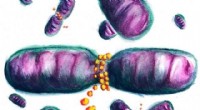
The Golgi apparatus is an organelle that modifies, sorts, and packages proteins and other molecules for secretion or transport to other parts of the cell. It consists of a series of flattened sacs called cisternae, which are stacked together and surrounded by a membrane. The Golgi apparatus receives proteins and other molecules from the endoplasmic reticulum (ER), and then modifies them by adding carbohydrates and lipids, and sorting them into vesicles for transport to their final destination. Some vesicles are transported to the cell membrane, where they fuse and release their contents outside the cell, while others are transported to other organelles within the cell.