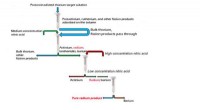
In electrochemistry, the movement of ions is what creates the electrical current. When a voltage is applied to an electrochemical cell, the positive ions (cations) are attracted to the negative electrode, while the negative ions (anions) are attracted to the positive electrode. This movement of ions creates an electrical current.
The term "cation" is also used in chemistry to refer to positively charged atoms or molecules. For example, the sodium ion (Na+) is a cation, as it has lost one electron from its neutral state. Similarly, the calcium ion (Ca2+) is a cation, as it has lost two electrons from its neutral state.