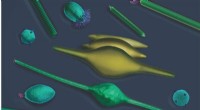
Reconstructed by Digital Paleontology Lab's Andrey Zhuravlev
Reconstructions of organisms that lived ~558 million years ago are helping scientists understand the lifestyles and habits of some of Earth's earliest animals, a period known as the Ediacaran. For instance, Dickinsonia, thought to be one of the first animals and looking vaguely like a quilted mattress, was a sessile filter feeder that may have lived in sandy or muddy environments. By contrast, another organism called Kimberella, which sported a segmented body, was a mobile predator.
These lifestyle differences, seen in organisms that arose before the famous "Cambrian Explosion" some 541 million years ago, are surprising and suggest that life was more diverse during this time than previously thought.
By digitally reconstructing the 3D shapes and behaviors of various organisms that lived during the Ediacaran and Cambrian periods, scientists are finding that different species already exhibited distinct and complex lifestyle behaviors.
This period—right before the Cambrian Explosion, which saw a sudden proliferation of animal life—is critical in understanding the origins and evolution of animal life on Earth.
While the diversity and complexity of some Ediacaran organisms suggests a sophisticated ecosystem, paleontologist Alex Liu of Cambridge University cautions against jumping to conclusions about this early period of life.
"In the Ediacaran, everything was kind of weird and wonderful, and so it can be difficult to compare them with modern animals and know what they were doing," Liu says.
One of the most detailed analyses of Ediacaran organisms comes from a recent effort to recreate the extinct organisms Opabinia and Anomalocaris. The reconstructions, part of a project by the University of Cambridge, the University of Leicester and the University of Bristol, suggest these organisms were not simply passive filter feeders, as scientists had previously thought, but were in fact active predators.
While the behavior of these organisms, the fossils for which were found in what is now Canada, may seem more advanced than expected for their time, Liu argues that such behavioral complexity can even evolve early on in an ecosystem's history because natural selection acts most strongly on the reproductive stages of a species' life cycle.
"Most paleontologists and evolutionary biologists would agree that the early Earth offered great opportunities for fast biological diversification, and that the competition between early animals played an important role in pushing evolution," Liu says. "The complex behaviors we reconstructed in these Ediacaran animals likely evolved as an outcome of this competition."
Another possibility, he adds, is that early organisms were already very successful without needing to develop complex behavioral repertoires. But increased ecological competition among early animals could force species to evolve more sophisticated behaviors—such as predation—as a way of gaining a competitive advantage.