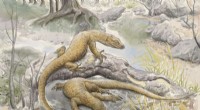
The fossil, a 508-million-year-old ring of teeth, provides evidence that the common ancestor of these animals had a segmented body and complex mouthparts.
This discovery changes our understanding of the early evolution of molting animals. It suggests that the last common ancestor was smaller and simpler than previously thought.
Teeth Rings and Common Molting Creature Features:
This ancient ring of teeth offers valuable insights into the characteristics and diversity of the common ancestor of these species:
Segmented Body:
One noticeable feature revealed by the teeth ring is the presence of a segmented body plan. Segmentation is a fundamental trait shared by various arthropod groups and molting animals in general. This discovery affirms that segmentation originated early in the lineage of this ancient ancestor.
Head Structures:
The fossil ring exposes intricate mouthparts indicating specialized feeding habits of this ancient creature. Although a head or other body parts aren't preserved alongside the teeth ring, its presence implies a specialized head region with feeding structures, hinting at complex behaviors beyond simple passive filtering.
Size Estimation:
Based on comparative analysis with related species, scientists estimate that the common ancestor possessed a small body size, likely smaller than a grain of sand. This finding contrasts with previous assumptions of a considerably larger size. However, the fossil doesn't reveal whether their tiny nature was consistent across molting groups or evolved within diverse branches over time.
Diversity and Specialization:
While the preserved features illustrate adaptations of this ancestor, they still fall short of revealing the broader morphological diversity among ecdysozoans. Comparative examination with diverse subgroups is warranted to elucidate this and better grasp the initial steps leading to their extraordinary adaptive diversification seen in today's extant relatives.
In closing, the 508-million-year-old discovery of this teeth ring is of remarkable significance as it helps unravel the mysteries surrounding the common ancestor of molting animals. The insights garnered challenge existing understandings and prompt new inquiries, pushing the frontiers of knowledge to understand the intricate evolutionary history and diversification of one of the most dominant animal groups on Earth.