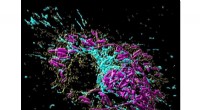
In a new study, researchers at the University of California, San Francisco (UCSF) have identified a molecular mechanism that controls how cells sort and rearrange themselves into three-dimensional shapes. The researchers found that a single-cell asymmetry, which is controlled by the activity of a specific gene, is responsible for determining the shape of a group of cells.
The researchers used a combination of experimental and computational approaches to study the process of cell sorting and rearrangement in the fruit fly Drosophila melanogaster. They found that a gene called dachsous is expressed asymmetrically in cells, and that this asymmetry controls the direction in which cells move. By manipulating the activity of dachsous, the researchers were able to change the shape of groups of cells.
The researchers believe that this mechanism of single-cell asymmetry could be a general principle that controls cell sorting and rearrangement in many different developmental contexts. This finding could have implications for understanding how tissues and organs form during development, and how these processes go wrong in diseases such as cancer.
The study was published in the journal Nature Cell Biology.