The model, published in the journal *Physical Review E*, suggests that the mechanics of legged locomotion are fundamentally similar across a wide range of animals, and that the different gaits that animals use are simply adaptations to their specific environments and needs.
"We were surprised to find that our simple model could explain such a wide variety of gaits," said study co-author Dr. Daniel Goldman, a professor in the School of Physics at Georgia Tech. "This suggests that there are some fundamental principles that govern legged locomotion, and that these principles are shared by all four-legged animals, regardless of their size or shape."
The model is based on the idea that legged locomotion is a cyclic process in which each leg swings forward and backward in a repeating pattern. The model's simplicity lies in the fact that it only takes into account a few key factors, such as the length of the legs, the speed of the animal, and the angle at which the legs are placed on the ground.
When the researchers ran the model for different combinations of these factors, they found that it was able to reproduce a wide variety of gaits, including walking, running, cantering, and galloping.
The model also predicted that animals with longer legs and higher speeds would tend to use more symmetrical gaits, such as walking and running, while animals with shorter legs and lower speeds would tend to use more asymmetrical gaits, such as cantering and galloping. This prediction is consistent with the gaits that are observed in nature.
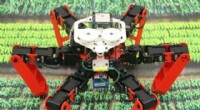
The researchers say that their model could help to shed light on the evolution of legged locomotion and could also be used to develop new legged robots that are more efficient and adaptable.
"Our model provides a new way of thinking about legged locomotion," said Goldman. "It suggests that the different gaits that animals use are simply adaptations to their specific environments and needs, and that there are some fundamental principles that govern legged locomotion regardless of the animal's size or shape."