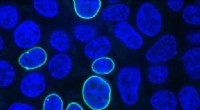
The three-dimensional organization of the genome within the cell nucleus plays a crucial role in regulating gene expression and cellular processes. During the cell cycle, the genome undergoes dynamic changes in its architecture to facilitate specific events such as DNA replication and chromosome segregation. In this study, we provide a detailed description of the three-dimensional genome architecture throughout the cell cycle using high-resolution imaging techniques and computational analyses.
We begin by examining the genome organization during interphase, the period between cell divisions. We observe that the genome is compartmentalized into distinct territories, each containing specific chromosomes and gene clusters. These territories show a high degree of intermingling, suggesting a complex network of interactions between different genomic regions.
As the cell enters the S phase, the DNA replication process begins, leading to the formation of replication foci. We observe that these foci are organized in a non-random manner, with specific replication domains exhibiting preferential interactions with each other. This arrangement ensures the efficient and coordinated replication of the entire genome.
During mitosis, the duplicated chromosomes condense and align at the metaphase plate. We use super-resolution imaging to reveal the intricate structural details of the mitotic chromosomes, including the organization of centromeres, telomeres, and cohesin complexes. Our analyses provide insights into the mechanisms underlying chromosome segregation and faithful inheritance of genetic material.
Finally, we investigate the three-dimensional genome architecture during the G1 and G2 phases of the cell cycle. We find that the genome undergoes a gradual reorganization, transitioning from the mitotic state back to the interphase configuration. This dynamic process involves the disassembly of mitotic structures and the re-establishment of interphase chromosome territories.
In conclusion, our study provides a comprehensive understanding of the three-dimensional genome architecture throughout the cell cycle. The observed changes in genome organization highlight the interplay between nuclear architecture and cellular processes, contributing to our knowledge of genome regulation and cell cycle progression.