Mother-of-pearl, also known as nacre, is a natural composite material found in the shells of mollusks. It consists of aragonite, a form of calcium carbonate, arranged in a brick-and-mortar structure with layers of organic material in between. This unique structure gives mother-of-pearl its remarkable strength, hardness, and toughness, making it one of the most resilient materials in nature.
The self-assembly process of mother-of-pearl has long fascinated scientists. Understanding how these materials form their hierarchical structure could pave the way for the development of new high-performance materials with similar properties.
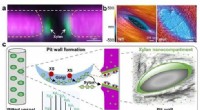
In the study, researchers used a combination of advanced imaging techniques and computational modeling to investigate the self-assembly process of mother-of-pearl. They found that the formation of the material involves a complex interplay between the inorganic aragonite crystals and the organic matrix.
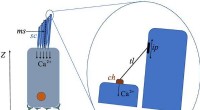
The organic matrix, composed of proteins and polysaccharides, acts as a template for the growth of aragonite crystals. These crystals nucleate and grow on the organic matrix, guided by the interactions between the organic molecules and the calcium ions in the surrounding environment.
The researchers identified specific proteins that play crucial roles in the self-assembly process. These proteins control the nucleation, growth, and orientation of the aragonite crystals, ultimately leading to the formation of the highly ordered and hierarchical structure of mother-of-pearl.
The findings from this study provide a deeper understanding of the self-assembly mechanisms of mother-of-pearl and open up new possibilities for the design and fabrication of bioinspired materials. The ability to mimic the self-assembly processes found in nature could lead to the development of advanced materials with enhanced mechanical properties, optical properties, and functional properties.
The study also highlights the potential of combining advanced imaging techniques and computational modeling to investigate complex biological systems and materials. This interdisciplinary approach can provide valuable insights into the fundamental processes underlying the formation and properties of natural materials, inspiring the design of novel materials with tailored properties for various applications.