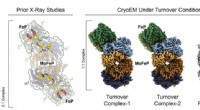
Molecular motors move along cytoskeletal filaments, which are long, thin protein filaments that form a network inside the cell. The motor proteins bind to the filaments and use the energy from ATP hydrolysis to move along them.
The exact mechanism by which molecular motors move is still not fully understood, but it is thought that they use a hand-over-hand mechanism. In this mechanism, the motor protein binds to the filament with two heads. One head then releases the filament and binds to the next one in front of it. The other head then releases the filament and binds to the next one in front of it, and so on. This process repeats itself, allowing the motor protein to move along the filament.
The speed at which molecular motors move depends on the type of motor protein and the load that it is carrying. Some motor proteins can move at speeds of up to 100 nanometers per second, while others can only move at speeds of a few nanometers per second.
Molecular motors are essential for the proper function of cells. They are involved in a wide variety of cellular processes, and their malfunction can lead to a variety of diseases.
Here is a more detailed explanation of the hand-over-hand mechanism:
1. The motor protein binds to the filament with two heads.
2. One head releases the filament and binds to the next one in front of it.
3. The other head then releases the filament and binds to the next one in front of it, and so on.
4. This process repeats itself, allowing the motor protein to move along the filament.
The hand-over-hand mechanism is a very efficient way for molecular motors to move along filaments. It allows them to move quickly and smoothly, even when they are carrying heavy loads.
Molecular motors are also very versatile. They can move in both directions along the filament, and they can even change direction mid-way through their movement. This versatility allows molecular motors to perform a wide variety of tasks in the cell.
Molecular motors are essential for the proper function of cells. They are involved in a wide variety of cellular processes, and their malfunction can lead to a variety of diseases.