Inbreeding depression is defined as reduced fitness or performance arising from increasing homozygosity of progenies due to successive inbreeding, whereas heterosis refers to the superiority of a hybrid over its parent resulting from the increase in heterozygosity. These two closely related phenomena are of fundamental importance to crop breeding and evolutionary biology.
Despite a comprehensive understanding of heterosis, the genetic basis of inbreeding depression has been debated for a long time, especially in self-pollinating species such as rice. Therefore, Xiaodong Xu and his colleagues in Zhang and Ouyang' group performed a complete dissection of the genetic basis of inbreeding depression, using a continuous inbreeding population derived from an elite hybrid rice.
The findings are published in the journal Science China Life Sciences.
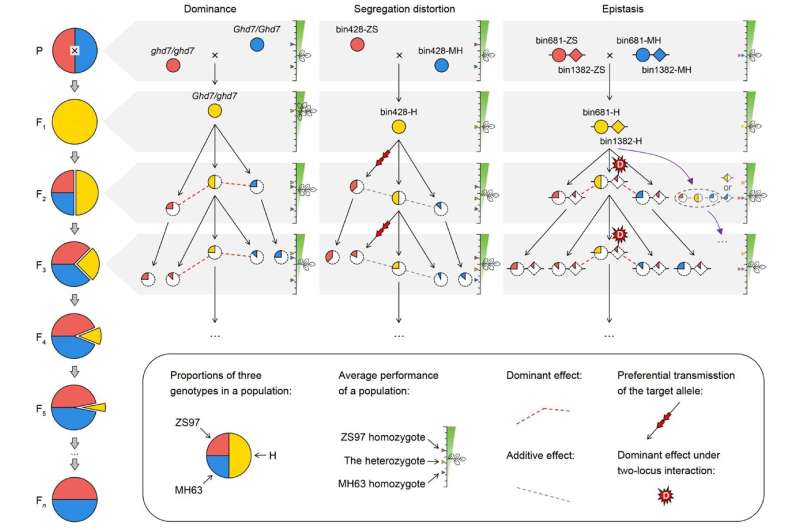
Variable degrees of inbreeding depressions were detected for all traits except heading date, showing continuous and reduced declines from F1 to F5 generation due to the continuous halving of heterozygosity among generations.
Using three panicle traits as models, it was found that increased homozygosity for alleles at quantitative trait loci (QTLs) with positive dominant effects, which contributed to heterosis of the hybrid relative to its parents, can lower the performance of the offspring and explain a large portion of inbreeding depression. These loci with dominant effects constitute the main correlation between heterosis and inbreeding depression.
However, distinct from heterosis, a biased transmission ratio of alleles for QTLs with either dominant or additive effects in the segregation distortion region would also change the expected homozygosity and thus lead to slight depression effects. When an allele with low performance was preferentially transferred in the offspring due to segregation distortion, the extent of depression will increase.
In addition, two-locus interactions may change the extent and direction of the depression effects of the target loci, and overall interactions would promote inbreeding depression among generations. Moreover, the actual inbreeding depression was evaluated between generations considering the heterozygosity decay in the background after inbreeding.
The researchers found inconsistent or various degrees of background depression from the F2 to F3 generation assuming different genotypes of the target locus, which may affect the actual depression effect of the locus due to epistasis.
Taken together, the results suggest that the genetic architecture of inbreeding depression and heterosis is closely linked but also differs in their intrinsic mechanisms, which expands understanding of the whole-genome architecture of inbreeding depression. It will help breeders to integrate high-efficiency QTLs and heterotic heterozygotes to develop high-yield crops in the future.
This study was reported by Qifa Zhang and Yidan Ouyang' group from the National Key Laboratory of Crop Genetic Improvement, Huazhong Agricultural University, Wuhan, China.
More information: Xiaodong Xu et al, The genetic basis and process of inbreeding depression in an elite hybrid rice, Science China Life Sciences (2024). DOI: 10.1007/s11427-023-2547-2
Journal information: Science China Life Sciences
Provided by Science China Press