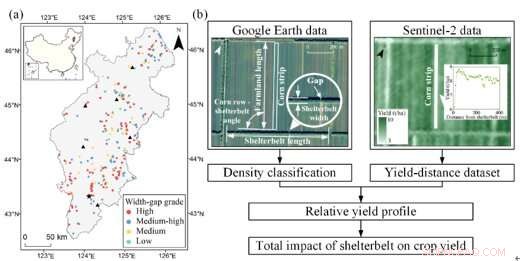
Flow chart for quantifying shelterbelt structure and yield increase based on Google Earth and Sentinel-2 data. Credit: Liu Yage
Shelterbelt has long been used as an important approach to protect farmland and increase crop yield. The reasonable shelterbelt structure design is of great significance to ensure food security. However, due to the limitation of methods, the influence of shelterbelt density on yield increase effect is still unclear.
A research team led by Prof. Li Huidong from the Institute of Applied Ecology of the Chinese Academy of Sciences has recently developed a new method to quantify the yield increase effect of shelterbelt and explored the impact of shelterbelt structure on yield increase effect on a large scale. The study was published in Environmental Research Letters.
The researchers found that shelterbelts could increase crop yields by 4.18% on average in Northeast China. The yield increase effect of leeward farmland was better than that of windward farmland.
Moreover, shelterbelt density significantly affected the yield increase effect. Shelterbelt with medium-high density had the best yield increase effect, which is the optimum shelterbelt structure for maximum crop yield.
"These findings provide new insights into the impact of shelterbelts on crop yields and guide the management of shelterbelt structures in practice to maximize crop yield," said Prof. Li.