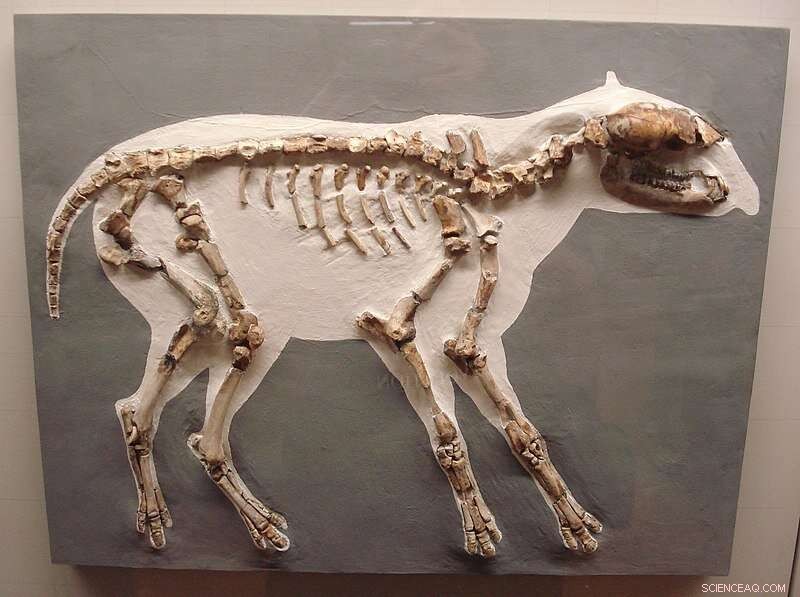
Fossil of plagiolophus. Credit: Ghedoghedo/Wikimedia Commons, CC BY-SA 3.0
A study by the UPV/EHU-University of the Basque Country into the paleodiet of extinct paleotheriidae (or pseudo horses) provides information about their feeding strategy and the environment they inhabited at the end of the Eocene. Plagiolophus was a highly selective perissodactyl and fed on tough foliage.
In collaboration with Dr. Gildas Merceron of the Université de Poitiers, the UPV/EHU's Vertebrate Paleontology research group, led by Leire Perales-Gogenola, has conducted a piece of research focusing on the paleodiet of the European paleotheriid Plagiolophus. These mammals are extinct equoid perissodactyla that inhabited Western Europe between the middle Eocene and early Oligocene (41 and 29 million years ago), before they became extinct during the climatic-biological crisis in the Eocene-Oligocene transition. Although hypomorph mammals (or equoids) are currently represented by only one genus (Equus) and just a few species of horses, donkeys and zebras, the diversity of these hypomorphs, which resembled today's horses, was much greater during the Eocene epoch (between 56 and 34 million years ago).
The results of the research have been published in the international journal Palaeogeography, Palaeoclimatology, Palaeoecology, included in the Science Citation Index. It is one of the most comprehensive works published on the paleodiet of Eocene mammals in relation to the climatic-biological crisis at the end of this epoch.
To analyze the paleodiet, three proxies or palaeoecological or paleoclimatic indicators were studied: hypsodonty or relative height of the crown of the teeth, and tooth wear (of the enamel), both mesowear and microwear. In the case of microwear, the DMTA (Dental Microwear Textural Analysis) was studied at the University of Poitiers. The aims of this palaeoecological analysis were: to infer the paleodiet of the palaeotheriid Plagiolophus throughout its life and in the short term, and to study whether there were any changes in the feeding strategies of the various species in relation to the climatic cooling that began at the end of the middle Eocene and culminated in the Eocene-Oligocene transition.
The results shed light on the diet of one of the most abundant ungulates of the Eocene in Europe. Plagiolophus was a highly selective perissodactyl and fed on tough foliage (leaves of monocotyledons or dicotyledons), avoiding lignified materials (such as roots or tree bark) or hard materials. The results indicate that the diet of the various species is independent of geographical location (e.g. Castile, Catalonia, Aquitaine or Provence) and chronology (Eocene or Oligocene). No seasonal variations were found either, meaning that their diet was the same whether it was summer or winter. This selective diet may have been key to their survival in the Eocene-Oligocene transition 34 million years ago.
The UPV/EHU's Vertebrate Paleontology group, in collaboration with the PALEVOPRIM laboratory of the Université de Poitiers, is currently immersed in the study of the paleodiet of other genera of paleotheriidae, in order to explore their biological response to the paleoclimatic change during the Eocene-Oligocene transition. This study is part of Leire Perales-Gogenola's Ph.D. thesis project, which also includes the study and description of new genera and species of paleotheriidae during the Eocene in Europe. In the context of her Ph.D. thesis, two new species of the palaeotheriid Leptolophus have been described. In addition, the description of a new genus of palaeotheriid, represented by two new species, is in preparation. They are paleotheriidae endemic to the western Iberian region.