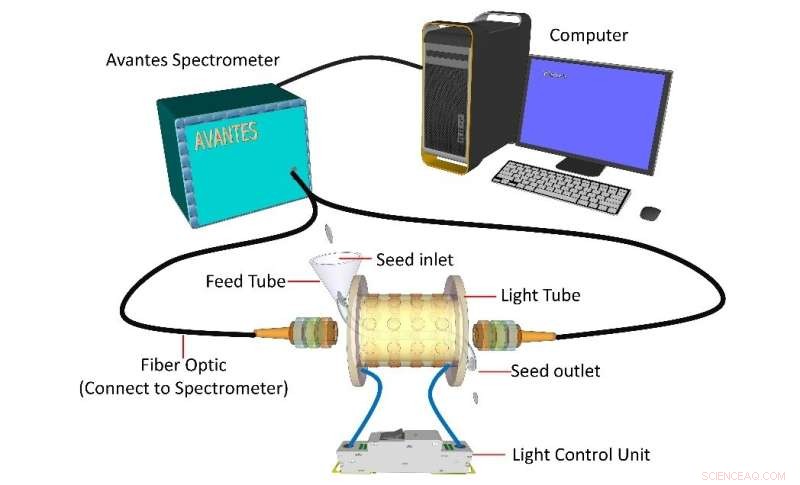
The structure of NIR single-grain high-throughput quality analysis instrument. Credit: Fang Shuang
A novel single-grain composition analysis technology has recently been developed to help evaluate the eating quality of hybrid rice, according to a research team led by Prof. Wu Yuejin from the Hefei Institutes of Physical Science of the Chinese Academy of Sciences.
They found that the eating quality of hybrid rice was not only related to the chemical composition of the rice, but was also influenced by the variation in single-grain chemical composition.
Results were published in the journals Agriculture and Foods.
Rice is one of the major food crops worldwide. Amylose, protein, and fat are important quality traits of rice and have important effects on eating quality, storage quality and processing quality. Near-infrared (NIR) spectroscopy has the advantages of nondestructive, rapid, and nonpolluting in detecting crop quality, but it's hard to achieve high-throughput accurate detection of single-grain quality traits in isolated populations for genetic breeding.
In their previous study, the researchers designed and manufactured an intelligent single-grain crop quality detection and sorting instrument. Based on this high-throughput single-grain quality NIR detection platform (2–3 grains/second), they developed models to explore the best conditions for detection and sorting. Accordingly, they determined the amylose and fat content of individual rice grains.
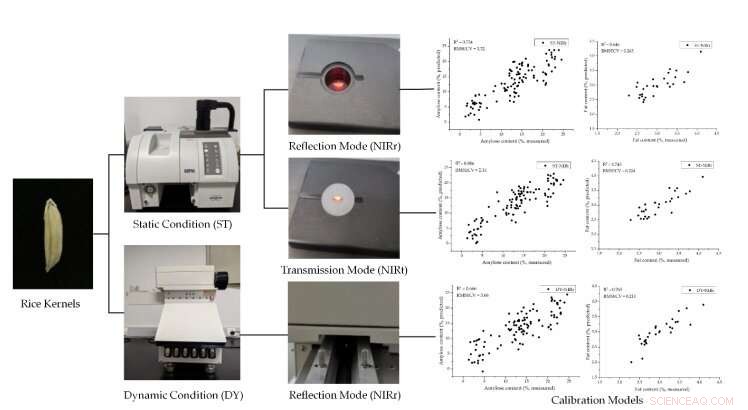
Schematic diagram of different platform-based methods for detecting composition of individual rice grains. Credit: Fang Shuang
They compared the data under two different conditions. Under static measurement conditions. The coefficient of determination (R2) values were 0.886 and 0.743 for the modeling of amylose and fat content. And under dynamic measurement conditions, R2 values were 0.666 and 0.765.
"The process was rapid and nondestructive," said Cheng Weimin, first author of the study, "and when evaluating the eating quality of hybrid rice, we found the reasons for the varying eating quality of hybrid rice using single-grain quality trait analysis techniques."
According to the researchers, the high-quality hybrid rice has the following characteristics: firstly, the physicochemical indicators for a large sample size meeting the national standards were the determining requirement, and secondly, the small variation in the single-grain composition was the important requirement.
R2 of the eating quality model increased from 0.657 to 0.850 when the single-grain composition variations were added to the independent variables (amylose content, protein content, alkali spreading value, and gel consistency).
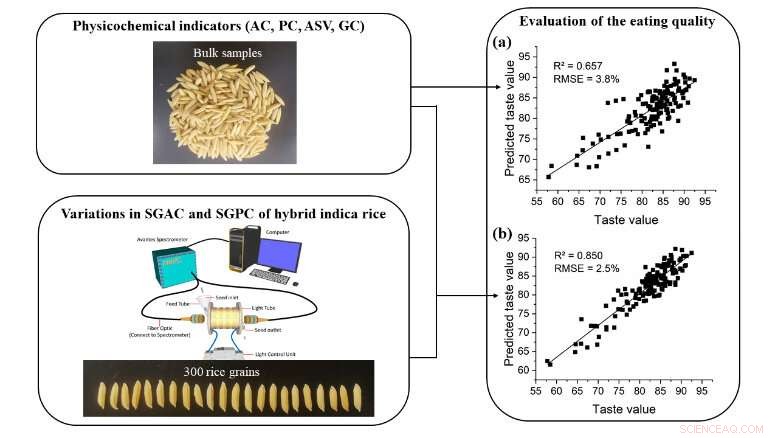
The eating quality model of hybrid indica rice established with physicochemical indicators as independent variables (a), the dispersion indicators of single-grain composition and physicochemical indicators as independent variables (b). Credit: Fang Shuang
In addition, the effect of sterile lines on the eating quality of hybrid rice was greater than that of the restorer lines, so selecting high-quality sterile lines was particularly important for the selection of good-tasting combinations.
This was a new method to evaluate the eating quality of hybrid rice and laid the foundation for high yield and quality breeding of hybrid rice.