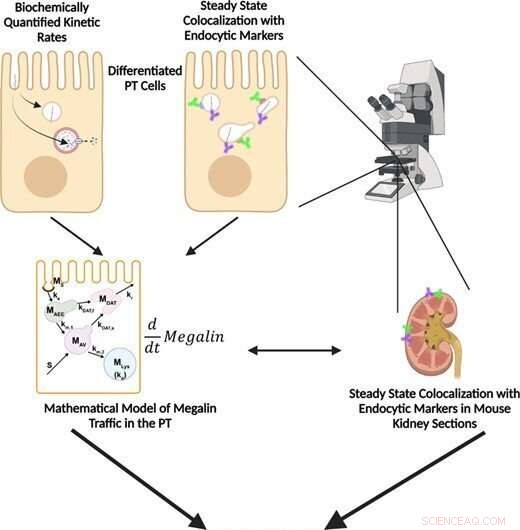
Credit: Katherine E Shipman et al, Function (2022). DOI: 10.1093/function/zqac046
Research published ahead of print in the journal Function presents a new mathematical model using opossum kidney cells to study the endocytic capacity of proximal tubule cells in the kidneys.
The specialized cells in the proximal tubule—the main area of the kidneys' functional unit responsible for water and potassium reabsorption—have a high capacity for endocytosis, a process that brings substances into the cells. In the proximal tubule, endocytosis is responsible for ensuring the urine is free of protein. "Gaps in our knowledge reflect both the complexity of the endocytic pathway itself and the technical challenges of studying [proximal tubule] function in vivo," researchers of the new study wrote.
The research team from the University of Pittsburgh School of Medicine developed a mathematical model using "biochemical and quantitative imaging methods in a highly-differentiated model of opossum kidney cells and in mouse kidney in vivo to develop mathematical models of megalin traffic." Megalin is a protein that acts as an endocytic receptor in the proximal tubule and contributes to protein reabsorption.
"In summary, our data support the utility of [opossum kidney] cells cultured under continuous orbital shear stress as a physiologically relevant model to unravel the regulation of membrane trafficking in [proximal tubule subsegment] S1 segment cells. This model can be readily adapted to understand the impact of genetic mutations and other disease conditions that impair endocytic recovery of filtered ligands and identify the molecular mechanisms impacted," the researchers wrote. + Explore further