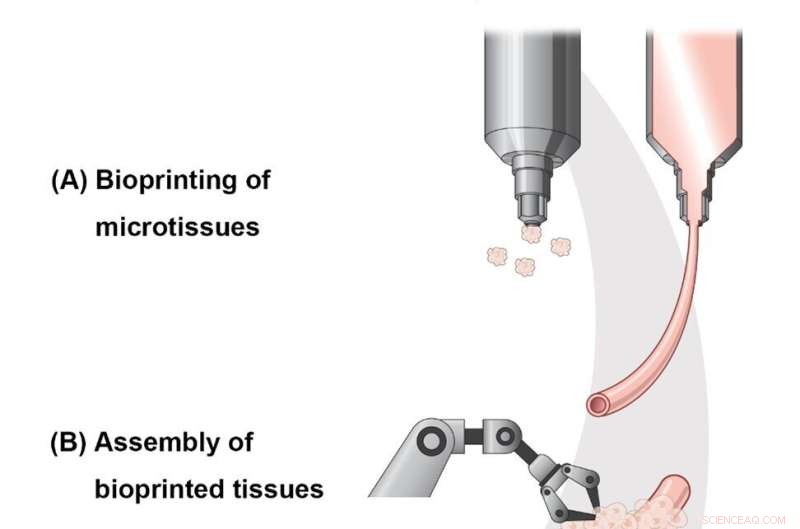
Generation process of engineered organs from bioprinting to assembly. Credit: POSTECH
How advanced is the technology for creating live, moving organs for the human body using 3D printers? Bioprinting research in engineering tissues with bioink containing living cells has been on the rise. Depending on the method for assembling bioprinted tissues, larger tissues or organs can be created, which is leading to a new era of personalized treatment for patients.
The research team led by Professor Jinah Jang (Department of Convergence IT Engineering, Department of Mechanical Engineering) with Ph.D. candidates Yeonggwon Jo and Dong Gyu Hwang (School of Interdisciplinary Bioscience and Bioengineering) at POSTECH has developed a method for engineering organs at scale using bioprinting. The findings from the study were recently published in the international journal Trends in Biotechnology. Professor Jinah Jang is an accomplished researcher on tissue engineering using 3D bioprinting.
In previously published studies, only single tissues could be fabricated at a time, and the size of the tissue was very small. Moreover, additional elements were required for the 3D printed organs to function like real tissues.
To overcome these issues, the research team presents a new bioprinting technology to engineer tissues similar to biological tissues. Their assembly method also offers the possibility of creating engineered organs bigger than the previous size limit.
Professor Jinah Jang explained, "If we combine technologies such as bioprinting, new materials, and stem cells, we can produce more realistic engineered organs. In combination with robotics or artificial intelligence (AI), more automatized and elaborate methods for generation of organ substitutes would be possible in the future." + Explore further