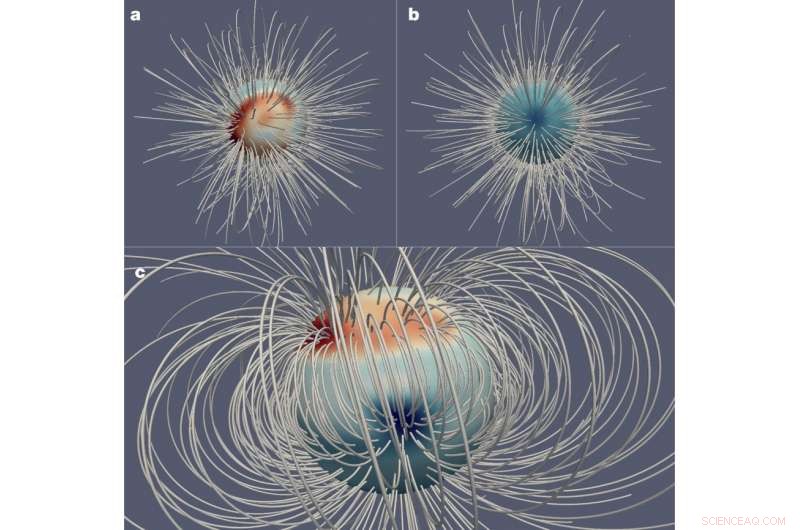
Magnetic field lines. a, North polar view; b, south polar view; c, equatorial view. The non-dipolar nature of the magnetic field in the northern hemisphere and the dipolar nature in the southern hemisphere is apparent. The equatorial view is centred near the Great Blue Spot and shows the linkage of magnetic field lines that enter through the Great Blue Spot. The contoured surface on which the field lines shown start and end is at r = 0.85RJ, where the density of field lines is proportional to the radial magnetic field strength and is depicted by the colour scale (red outward flux, blue inward flux). Credit: Nature (2018). DOI: 10.1038/s41586-018-0468-5
A team of researchers affiliated with several institutions in the U.S., including NASA and a pair from Denmark has found that Jupiter's magnetic field is quite different from Earth's. In their paper published in the journal Nature, the group describes their study of the planet using data from the Juno spacecraft, and what they found. Chris Jones, with the University of Leeds, offers a News and Views piece on the work done by the team in the same journal issue.
NASA launched Juno into space back in 2011, and it entered a close orbit around Jupiter in 2016—just 4,000 kilometers above its surface. Over the past two years, it has been monitoring the planet's magnetic field. In this new effort, the researchers reveal what the data shows.
When mapping a planet's magnetic field, it is common to use colored lines to show magnetic flux—doing so depicts the Earth's magnetic field as lines emanating outward from the north pole then circling back at the south pole. The result resembles a giant bar magnet. But the researchers report that things are different with Jupiter. While it does have flux lines emanating from its north pole, it also has two return points, rather than just one—one is located near its south pole, the other close to its equator. Also, on Earth, parts of the magnetic field do not favor either pole, and are instead spread between the two. With Jupiter, the same kinds of magnetic fields are almost all in the northern hemisphere.
There is also the matter of how the magnetic fields are generated. Earth's magnetic field is believed to be generated by its internal dynamo—the churning of electrically conductive fluids in the core. But Jupiter is thought to be made of helium and hydrogen, which are not very conductive. This has led to theories that suggest the great pressure exerted inside the planet resulted in the formation of liquid metallic hydrogen, which, as its name implies, conducts much like a metal.
The researchers note that thus far, there is no data that can explain Jupiter's odd magnetic field, but suggest it most likely has something to do with the planet's unique internal structure.
© 2018 Phys.org