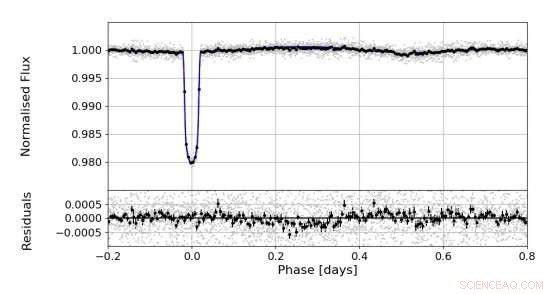
Phase folded light curve and the best fitting transit model of EPIC 219654213. Gray points are the measurements, black circles the binned data. The continuous line represents the best fitted model. Residuals to the fit are shown in the lower panel. Credit: Eigmuller et al., 2018.
An international team of astronomers has discovered a new eclipsing binary system composed of an M-dwarf orbiting a main sequence star. The transiting dwarf star exhibits the so-called relativistic beaming effect. The finding is reported in a paper published August 20 on the arXiv pre-print repository.
The relativistic beaming effect, also known as Doppler boosting, is the process by which relativistic effects modify the apparent luminosity of emitting matter that is moving at speeds close to the speed of light. The process is caused by the reflex motion of the stars introducing photometric flux variations due to the Doppler effect.
Measurements of the beaming effect are important for astronomers studying binary systems, as they allow independent estimate of the radial velocity of secondary components. This could be crucial in disclosing physical parameters and the nature of such systems.
Now, using data from NASA Kepler spacecraft's prolonged mission known as K2, a group of researchers led by Philipp Eigmuller of the German Aerospace Center (DLR) has studied the star EPIC 219654213, which was initially identified as a potential host for a planetary system.
However, K2 data complemented by follow-up spectroscopic observations with ground based observatories, including Keck telescope, Nordic Optical Telescope (NOT) and McDonald Observatory, indicate that EPIC 219654213 is a binary star. The observational campaign allowed also the scientists to determine fundamental parameters of the newly found system.
"In this paper, we present the detailed characterization of a DEB [detached eclipsing binary] formed by a main sequence star and an M dwarf companion with precise K2 photometry and ground-based radial velocity follow-up," the astronomers wrote in the paper.
The primary component of the system is a slightly evolved main sequence star of spectral type F7V. The star, about 4.1 billion years old, has a radius of approximately 1.52 solar radii and a mass similar to that of our sun.
The companion is a dwarf star of spectral type M5V. It is about five times smaller and less massive than the sun. The dwarf is on a nearly circular orbit around the primary star, orbiting it every 5.44 days. The components of the system are separated by approximately 0.065 AU.
The authors of the study also provided the details about the beaming effect observed in the system, focusing on its amplitude.
"The results show a change in the amplitude of the beaming effect of 35ppm, which account for 50 percent of the observed discrepancy between expected and observed beaming effect," the paper reads.
In concluding remarks, the researchers noted that EPIC 219654213 should be further investigated using exoplanet-hunting missions such as NASA's Transiting Exoplanet Survey Satellite (TESS) and ESA's PLAnetary Transits and Oscillations of stars (PLATO). More observations of this system may confirm if its smaller component is indeed an M dwarf or a brown dwarf or, what is also possible, a highly inflated "hot Jupiter" exoplanet.
© 2018 Phys.org