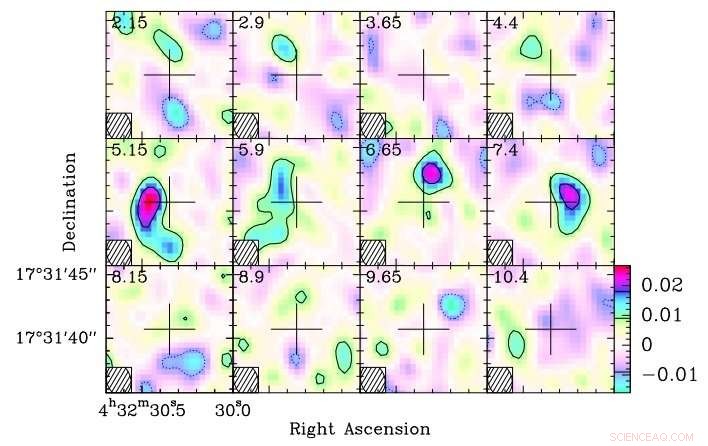
Channel maps H2S 1(1,0) - 1(0,1) emission from the protoplanetary disk around the star GG Tauri A. Credit: Phuong et al., 2018.
An international team of researchers has detected hydrogen sulfide emission from the dense protoplanetary disk around the star GG Tauri A. It is the first detection of this chemical compound in a protoplanetary disk. The finding is reported in a paper published August 2 on the arXiv pre-print server.
Located some 490 light-years away from the Earth in the Taurus-Auriga star-forming region, GG Tauri (GG Tau for short) is a quintuple system with the GG Tauri A (GG Tau A) triple star. GG Tau is known to have a dense ring located between 180 and 260 AU from it, and a large disk extending out to 800 AU. Due to its large size, low temperature (about 20 K) and large mass (about 0.15 solar masses), the disk is perceived by astronomers as an excellent target to search for cold molecular chemistry.
Recently, a group of astronomers led by Nguyen Thi Phuong of the University of Bordeaux in France, has conducted a chemical study of the circumstellar disk surrounding GG Tau A. Their research was focused on sulfur-bearing molecules, therefore, the scientists searched for hydrogen sulfide (H2S), carbon monosulfide (CS), sulfur monoxide (SO), and sulfur dioxide (SO2).
The study, carried out with the use of the NOrthem Extended Millimeter Array (NOEMA) interferometer located in Plateau de Bure in the French Alps, allowed the researchers to detect the hydrogen sulfide emission. As noted in the paper, this marks the first detection of that compound in a protoplanetary disk.
"Using NOEMA, we have observed the GG Tau A outer disk in several molecules. We report the first detection of H2S in a protoplanetary disk," the astronomers wrote in the paper.
According to the study, hydrogen sulfide is clearly detected with a peak signal-to-noise ratio of four in several channels. The scientists revealed that most of the line emission originates from the dense ring between 180 to 260 AU and extends up to 500 AU. They also found that the measured hydrogen sulfide column density is a factor of three greater than the upper limits for systems with disks like DM Tau, LkCa 15, MWC 480, and GO Tau, probably reflecting the larger disk mass of GG Tau A.
"Comparisons with other disks indicate that the detection of H2S appears to be facilitated by the large disk mass, but that the relative abundance ratios remain similar," the paper reads.
This, according to the researchers, indicates that GG Tau A could be a good test bed for studying chemistry in disks.
Besides hydrogen sulfide, the team also detected HCO+, H13CO+, and DCO+ in GG Tau A's protoplanetary disk. They added that the observed ratio of DCO+ to HCO+ is similar to those in other disks.
However, the researchers noted that they were not able to reproduce the observed column densities of sulfur-bearing molecules, even with low sulfur abundance, which suggests that the understanding of sulfur chemistry on dust grains is still incomplete.
© 2018 Phys.org