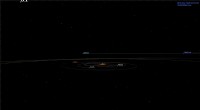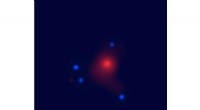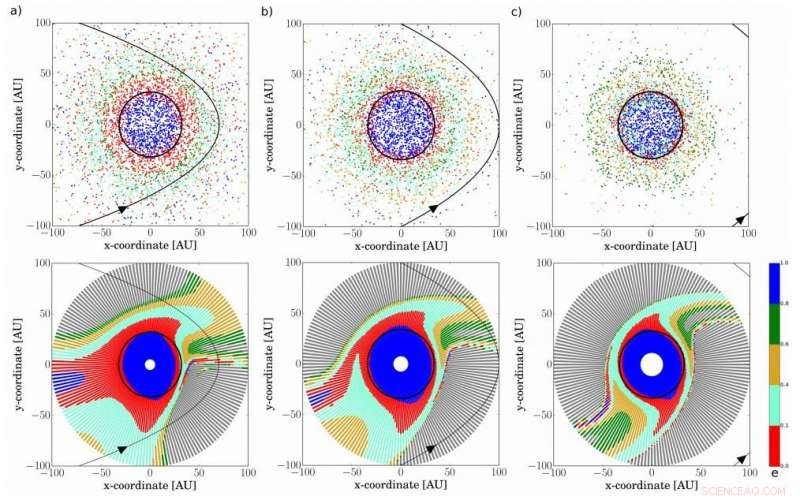
Effect of a prograde, parabolic fly-by of a star with a) M=0.5 M , b) M2= 1, M and c) M2= 5 M that is inclined by 60 degree and has a angle of periastron equal zero. The perihelion distance is always chosen in such a way as to lead to a 30-35 AU disc. The top row indicates the eccentricity distribution of the matter with a central area of most particles on circular orbits and more eccentric orbits at larger distances form the Sun. The eccentricities are indicated by the different colours given in the bar. The origin of the different eccentricity populations in the original disc can be seen in bottom row, where matter indicated in grey becomes unbound from the Sun. Note that in c) the path of the perturber is not visible because it is outside the shown frame. Credit: arXiv:1807.02960 [astro-ph.GA]
A team of researchers from the Max-Planck Institute and Queen's University has used new information to test a theory that suggests a rogue star passed close enough to our solar system millions of years ago to change its configuration. The group has written a paper describing their ideas and have posted it on the arXiv preprint server.
In recent years, space scientists have begun to suspect that something out of the ordinary happened to our solar system during its early years. Many have begun to wonder why there is not as much material in the outer solar system as logic would suggest. Also, why is Neptune so much more massive than Uranus, which is closer to the sun? And why do so many of the smaller objects in the outer solar system have such oddly shaped orbits? In addressing such questions, many space scientists have begun to wonder if a star might have wandered by during the early years of the solar system—coming just close enough to pull some of the objects in the outer parts of the solar system from their prior positions.
The idea of a rogue star has been debated for some time, but the theory has not been embraced because of the timing—if a star had wandered by, it would have been approximately 10 million years after the birth of the solar system. But objects in the outer solar system would have still just been forming, making it unlikely that they would have been impacted by a rogue star.
In their paper, the researchers with this new effort suggest that recent research by other teams studying the formation of other solar systems has shown that the outer parts of such systems can be more developed than their inner parts. They suggest that if that were the case for our solar system, then it is possible that the outer parts had matured to the point where they could have been impacted by the gravitational pull of a passing star. To test their theory, they created a simulation of just such a scenario and found that it very closely matched what we are able to see today—a solar system with odd characteristics at its outer edges.
© 2018 Phys.org