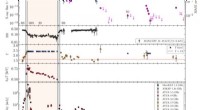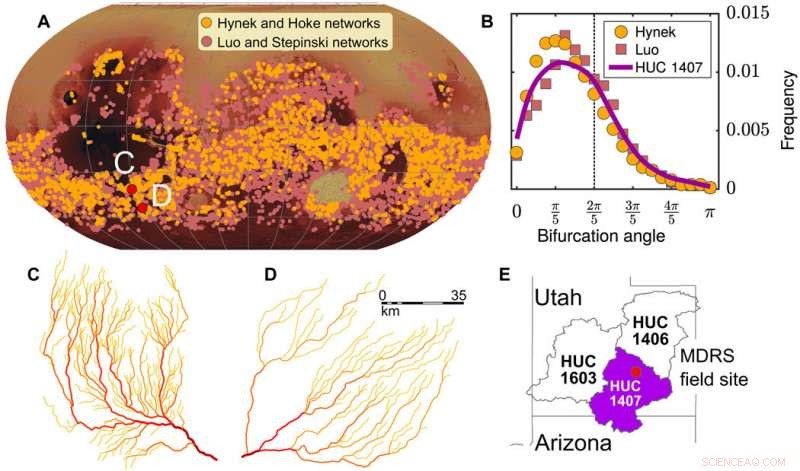
Comparison of mean valley branching angles on Mars and arid landscapes on Earth. (A) Outlet locations of the valley networks mapped by Hynek et al. (orange) and Luo and Stepinski (rose color). Background shading indicates elevation. The corresponding branching angle distributions are shown in (B). The violet solid line represents the branching angle distribution in the Lower Green River, a basin in the arid southwestern United States. The modes of the three data sets are 36° for the Hynek and Hoke networks, 45° for the Luo and Stepinski networks, and 41° for the Upper Colorado-Dirty Devil basin (HUC 1407). These values are considerably smaller than the theoretical angle of 2π/5 = 72° expected for groundwater-driven network growth (black dashed line). Two sample valley networks on Mars are shown in (C) and (D). Scale bar corresponds to both sites. (E) Map of the Upper Colorado-Dirty Devil basin (HUC 1407), where the MDRS (red circle) is located. Credit: (c) Science Advances (2018). DOI: 10.1126/sciadv.aar6692
A trio of researchers with ETH Zurich and the University of Chicago has found evidence that suggests narrow channel networks seen on the surface of Mars are due to heavy rainfall runoff. In their paper published on the open access site Science Advances, Hansjoerg Seybold, Edwin Kite and James Kirchner describe their study of the channel networks and comparisons they made with similar formations found here on Earth.
As the study notes, prior study of narrow channel networks on Mars has led researchers to believe they were likely created by a standing body of water. Other possibilities include groundwater sapping, fluvial runoff or even ice melting. Lack of direct evidence supporting any of the theories, however, has led to continuing debates. The researchers with this new effort have jumped into the fray by suggesting an alternative theory based on observations of Earth geography. They suggest work done by other researchers studying channel networks here on planet Earth offers a blueprint for the origins of channels on Mars. In that prior effort, other researchers had discovered a connection between the dryness of an area and the branching angles characteristic of some channel networks. Those in more arid areas, they found, tended to branch at narrower angles than did those in places exposed to more rainfall.
To find out if such evidence might be applicable to Mars, the researchers studied datasets containing information regarding the channel branching seen on Mars. In comparing two datasets from separate studies, they found similarities in descriptions of branching angles on Mars, both of which were compatible with the findings by the team studying channel networks on Earth—namely, that they had narrow angles. This, the researchers suggest, indicates a similar process was involved.
On Earth, the narrow channels resulted from infrequent rainfall runoff. Successive rainfalls led to deepening of the channels to their current depth. The researchers suggest the same is likely true for the branching networks on Mars. Rather than being formed by subtle movements of groundwater, they were likely carved into the ground by rushing water. Such an occurrence, they further note, would suggest that Mars had a very active hydrologic cycle.
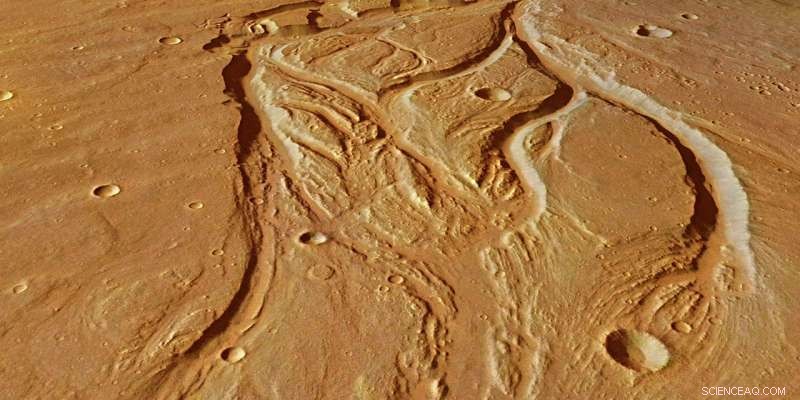
The central portion of Osuga Valles, which has a total length of 164 km. In some places, it is 20 km wide and plunges to a depth of 900 m. Credit: Photograph: ESA/DLR/FU Berlin, CC BY-SA 3.0 IGO
© 2018 Phys.org