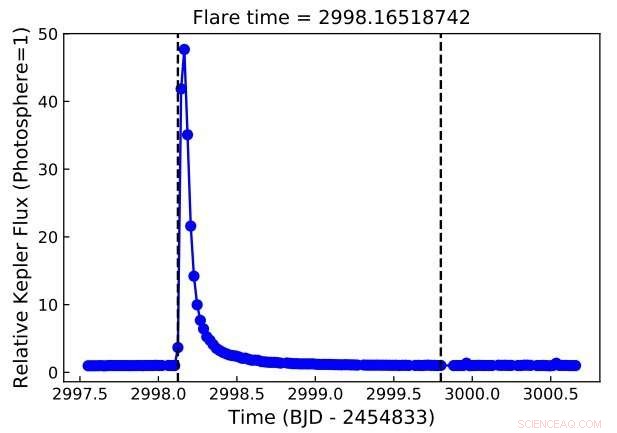
The strongest superflare observed on CFHT-BD-Tau 4. The blue dots represent the observed data. The dashed vertical lines represent the start and end times of flare. Credit: Paudel et al., 2018.
Using Kepler, astronomers have spotted two superflares on a very young brown dwarf known as CFHT-BD-Tau 4. The two superflares turn out to be the strongest flares observed on any brown dwarf so far. The finding is detailed in a paper published May 28 on the arXiv pre-print server.
NASA's exoplanet-hunting Kepler spacecraft lost its two reaction wheels in 2013, and the satellite was repurposed under the K2 mission to perform high-precision photometry of selected fields in the ecliptic. The revived space telescope is still an essential tool for astronomers studying stars and planets beyond our solar system.
During its Campaign 13, taking place between March 8 and May 27, 2017, K2 was used to observe a filed on the sky, which included the Taurus-Auriga star-forming region. Data from this observational campaign allowed a team of astronomers led by Rishi R. Paudel of the University of Delaware, to identify two huge flares on a brown dwarf CFHT-BD-Tau 4 located in this region of star formation.
With an estimated age of around 1 million years, CFHT-BD-Tau 4 (also known as 2MASS J04394748+2601407) was classified as a young brown dwarf of spectral type M7 at a distance of about 480 light years from the Earth. It has a radius of about 0.65 solar radii, mass of approximately 0.064 solar masses and an effective temperature of 2,900 K.
Paudel's team analyzed the flares on CFHT-BD-Tau 4, which resulted in important insights about flaring activity of this brown dwarf.
"We present photometric measurements of two superflares observed on a very young brown dwarf CFHT-BD-Tau 4, observed during Campaign 13 of the Kepler K2 mission," the researchers wrote in the paper.
According to the study, the stronger of the two observed flares, which lasted almost two days, brightened by a factor of about 48 relative to the quiescent photospheric level and had an estimated total bolometric energy up to 190 undecillion erg. Lasting nearly 10 hours, the weaker flare was found to be a complex (multipeaked) outburst that reached an estimated total bolometric energy of 4.7 undecillion erg.
The astronomers noted that the energies of the newly observed superflares are larger than these of the strongest flares reported on other young brown dwarfs, namely 2M0335+2342 and CFHT-PL-17. Hence, the outbursts described in the paper are the strongest flares observed on any brown dwarf to date.
In concluding remarks, the researchers wrote that the superflares found by them will be very helpful to understand how such flares impact the dynamical and chemical evolution of planet-forming disks around low-mass stars and brown dwarfs.
The authors of the paper added that the flares on CFHT-BD-Tau 4 might be helpful in explaining the mysteries regarding the formation of the chondrules and the calcium-aluminium-rich inclusions, which need transient heat sources to melt the precursor material. They underlined that it is currently impossible to explain the formation of these materials in the context of thermodynamic equilibrium between the pre-main-sequence stars and the disks around them.
© 2018 Phys.org