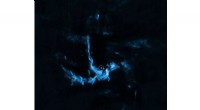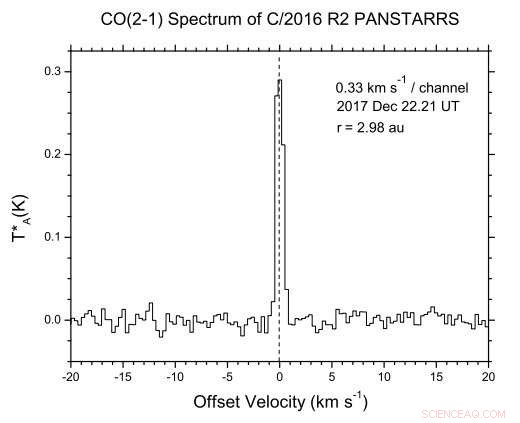
The first detection of CO emission in C/2016 R2 on UT 2017 Dec 22, when the comet was at r = 2.9 and ∆ = 2.1 AU. Credit: Wierzchos and Womack, 2018.
C/2016 R2 (Pan-STARRS) is a comet abundant in carbon monoxide and lacking hydrogen cyanide, according to a new study conducted by researchers from the University of South Florida (USF) in Tampa, Florida. The finding is detailed in a paper published May 17 on the arXiv pre-print repository.
Discovered on September 7, 2016, C/2016 R2 (Pan-STARRS) is an Oort Cloud comet orbiting the sun at a distance of about 740 AU, approximately every 20,000 years, on a highly eccentric orbit. The comet is known to have a deep-blue-colored coma and a very complex ion tail.
The Oort Cloud is perceived by astronomers as a reserve of cometary nuclei that contain ices dating back to the early solar system. Therefore, studying such comets as C/2016 R2 could provide important hints about the origin and formation of planets and other objects orbiting the sun.
C/2016 R2 was recently observed by USF's Kacper Wierzchos and Maria Womack. For their observations, conducted in December 2017 and January 2018, the astronomers employed the 10-m Submillimeter Telescope at the Arizona Radio Observatory. The observational campaign was focused on the search for carbon monoxide (CO) and hydrogen cyanide (HCN) emission in the comet.
"We used the Arizona Radio Observatory 10-m Submillimeter Telescope in order to search for CO J=2-1 (at 230.53799 GHz) and HCN J=3-2 (at 265.88643 GHz) emission in comet C/2016 R2 during 2017 December - 2018 January when its heliocentric and geocentric distances were r ~ 2.9 au and ∆ ~ 2.1 au, respectively," the paper reads.
As a result of the observations, the researchers detected neutral carbon monoxide emission in this comet for the first time. They found that the production rate of CO is very high and when compared to other comets, this rate is half that of C/1995 O1 Hale-Bopp at this same distance from the sun. Hence, C/2016 R2 is described by Wierzchos and Womack as a CO-rich comet in which carbon monoxide emission is assumed to be the primary driver of activity.
However, the researchers found that the production rate of hydrogen cyanide is much lower – about 100 times lower than observed for C/1995 O1 Hale-Bopp at the same distance. The researchers noted that the calculated CO/HCN production rate ratio of over 5,000 indicate an unusual chemical composition of C/2016 R2 that is difficult to understand in terms of typical comet compositions.
To better understand the peculiarity of C/2016 R2 the astronomers measured the production rate of molecular nitrogen (N2). They found that this comet is also N2-rich, not showing the typical nitrogen depletion seen in comets.
According to the authors of the paper, the calculated values underline the oddity of C/2016 R2. "R2's coma composition is clearly very different from other comets observed thus far, both in the high N2 abundance, and significant decrease in other typically abundant molecules, such as HCN," the researchers concluded.
© 2018 Phys.org