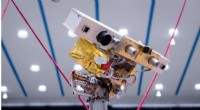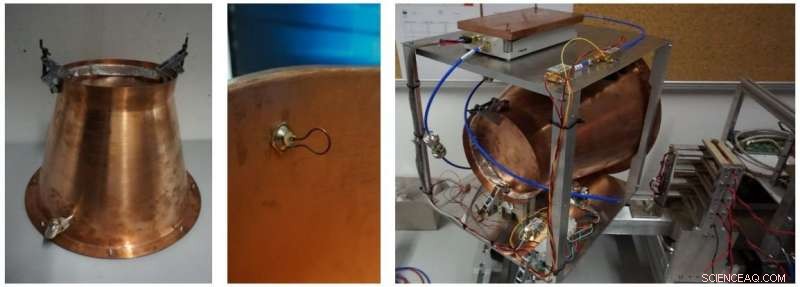
EMDrive Thruster: Cavity (Left), Antenna (Middle) and On Balance (Right). Credit: Martin Tajmar, et al.
A team of German physicists with TU Dresden has independently tested the feasibility of the EmDrive and Mach Effect Thrusters. They have presented their findings at this year's Aeronautics and Astronautics Association of France's Space Propulsion conference.
The EmDrive is an experimental space engine design that came to light several years ago. It gained some prominence two years ago after NASA reported a team had been testing the engine to find out if it had merit. That team has not presented its findings, which led the team in Germany to test the idea for themselves.
The idea behind the EmDrive is simple—it is a hollow cone made of copper or other material and placed in a frame. Natural microwaves bouncing around inside the cone are supposed to provide thrust. If feasible, such an engine could push a rocket through space without the need to carry fuel. But as many physicists have pointed out, such an engine would defy the laws of physics as we know them. To test this concept anyway, the team in Germany built an EmDrive similar to the one NASA had looked at (a leaked paper offered some details), set it inside a highly shielded vacuum chamber and fired microwaves at it. They report that while the EmDrive did experience thrust, the thrust did not appear to come from the engine itself—there was thrust no matter which direction the engine was pointing, suggesting it originated from a secondary source, possibly magnetism from the Earth.
Mach Effect Thrusters have a stronger basis in known science, but are still considered to be an unlikely proposition. They are based on the idea that fluctuations generated in a piezo-crystal stack will create non-zero time-averaged thrust. The researchers in Germany built some for testing in their vacuum chamber, as well. They report that the results were more promising than for the EmDrive, but there is still not enough evidence to show such an idea might work. They found that the thrusters did provide thrust and they did it in the right direction. They also noted that thrust ceased when the thrusters were turned off. But they also found that the thrust produced was approximately 100 times more than was predicted by theory. Also, throwing the thrusters into reverse did not work, either. The researchers suggest there was likely an outside factor impacting the generated thrust.
© 2018 Phys.org