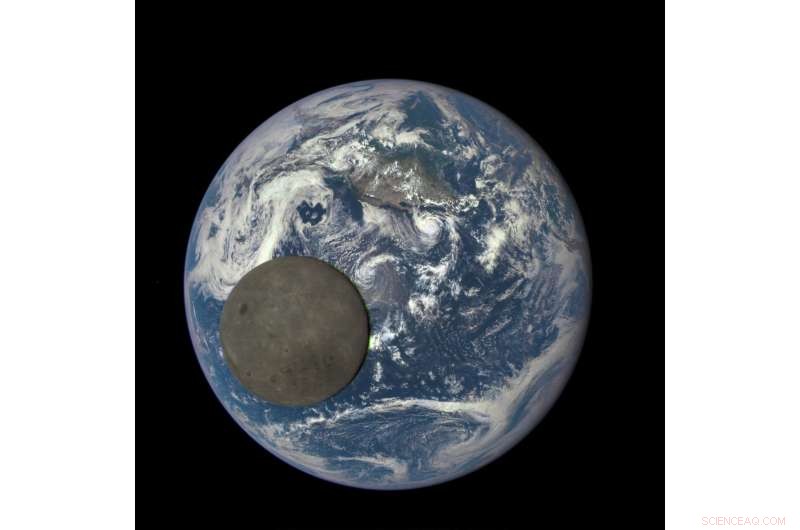
This image shows the far side of the Moon, illuminated by the Sun. Credit: NASA
A team of researchers from the U.K., France and the U.S. has found evidence that suggests that most of the water on Earth was present before the impact that created the moon. In their paper published on the open access site Science Advances, the group describes their study and comparison of moon and Earth rocks, and what they found.
The prevailing theory regarding how the moon's origin is that a Mars-sized protoplanet slammed into protoplanetary Earth, and the ejected material coalesced to form the moon. The prevailing theory regarding how water came to exist on Earth is that most of it was delivered by asteroids and comets. In this new effort, the researchers present evidence that bolsters the first theory but conflicts strongly with the second.
The team studied both moon rocks brought back to Earth by the Apollo astronauts and volcanic rocks retrieved by others from the ocean floor. The researchers looked specifically at oxygen isotopes. Studying isotopes in rocks offers scientists a means for comparing material from different origins such as asteroids, planets or even comets—each tends to have its own unique composition signature.
The researchers report that oxygen isotopes from the moon and Earth are remarkably similar—they found just a three to four ppm difference between them. This finding bolsters the theory that the moon was formed from material from the Earth due to a collision. But it runs counter to the idea that water came from comets or asteroids, because if it had come from such sources, the isotopes would have differed from those found in rocks on the moon. Thus, most of the water that was present in the protoplanetary Earth likely survived the impact, suggesting it did not come from elsewhere.
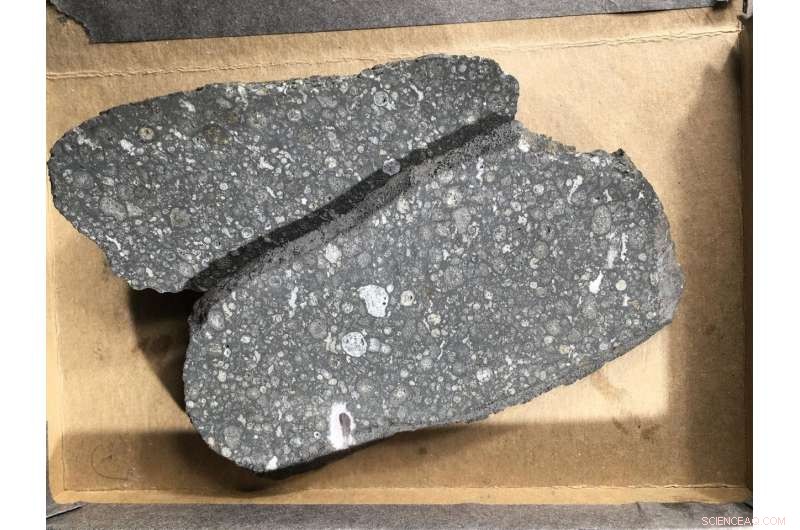
Meteorites such as these carbonaceous chondrites are thought to have delivered water to the Earth--but an outstanding question is when. A new study points to the early incorporation of water in the growing Earth. Credit: Nicolas Dauphas
The idea that water could survive such an impact has implications for the search for life beyond our solar system—exoplanets that are thought to have suffered collisions are typically removed from lists describing possible life-sustaining celestial bodies. Now, they may have to be included.
© 2018 Phys.org