Credit: Australian National University
A team of researchers from the U.S., New Zealand, Australia and Germany has found evidence suggesting that a type of star formation near the center of the Milky Way is responsible for large gamma ray emissions, not dark matter. In their paper published in the journal Nature Astronomy, the group describes their study of the stars in the formation, what they found, and what it could mean for dark matter theory.
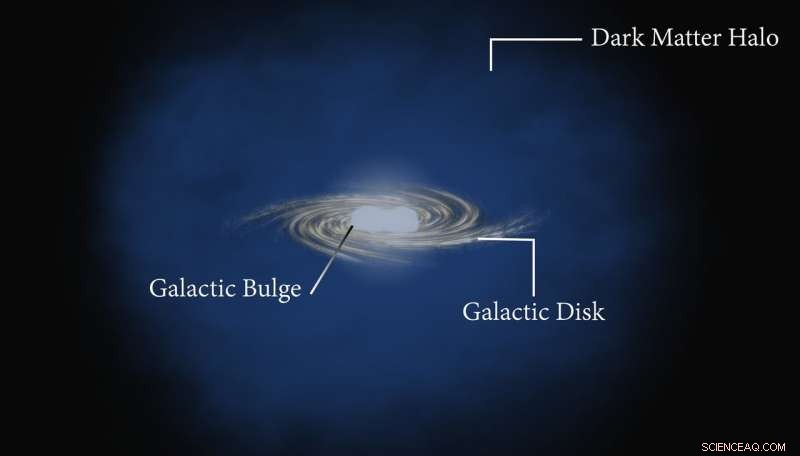
Over the past several years, a consensus of sorts has emerged among astrophysicists to explain the large gamma ray emissions from the center of the Milky Way—they are likely due to dark matter particles (WIMPs) bumping into each other or with regular matter, it was theorized. But in this new effort, the researchers report evidence of another source, casting doubt on dark matter as the likely cause of the emissions.
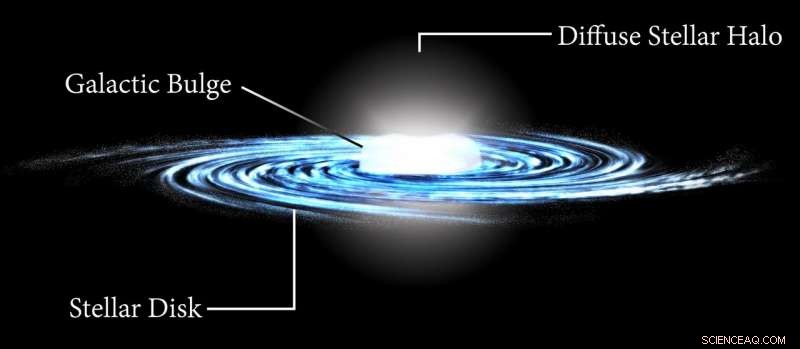
The researchers have been studying data from the Fermi Gamma-Ray Space Telescope, which has been in orbit for the past decade. They were able to see that the gamma rays actually mirrored the distribution of stars near the center of the galaxy—they were formed in the shape of an X, not a sphere as would be expected if it were caused by dark matter interactions. In building a model to recreate what they had found, the team discovered that a more likely explanation was a collection of millisecond pulsars (rapidly spinning neutron stars)—their combined emissions appeared to have merged to create the signal that was originally attributed to dark matter—the new source may be less exciting, they note, but at least it is explainable in reasonably concrete terms.
Credit: Australian National University
The researchers note that while their findings offer the most likely explanation for the gamma ray signals, which constitutes progress in understanding our own galaxy, they also put a bit of a damper on enthusiasm for dark matter—the case for it goes back to things like light bending in odd ways, or the strange behavior observed in some galaxies, which do not offer much to go on.
© 2018 Phys.org