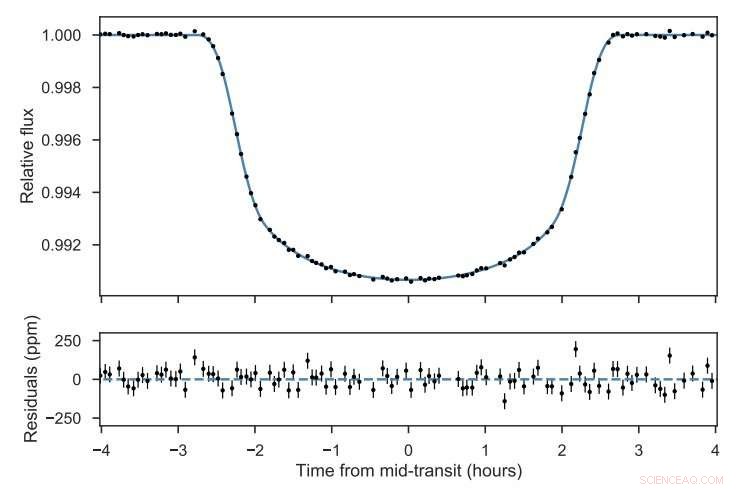
The top panel shows the phase folded Kepler K2 photometry (black points) as a function of time at the time of transit for EPIC 247098361 b, and the model constructed with the derived parameters of exonailer (blue line). The bottom panel shows the corresponding residuals. Credit: Brahm et al., 2018.
Using data from NASA's prolonged Kepler mission, known as K2, astronomers have found a new "warm Saturn" exoplanet. The newly discovered alien world, named EPIC 247098361 b, is similar in mass to Saturn, but much hotter. The finding is reported February 24 in a paper published on arXiv.org.
The new extrasolar world was first spotted by K2 as a planetary candidate during the spacecraft's Campaign 13 between March and May 2017, when it obtained the light curve of the star EPIC 247098361. In order to confirm the planetary status of the newly identified object, a team of astronomers led by Rafael Brahm of the Millennium Institute of Astrophysics in Chile has carried out follow-up observations using ground-based telescopes at ESO La Silla Observatory in Chile.
For the follow-up spectrographic campaign, the researchers employed the Coralie spectrograph mounted on the 1.2m Euler/Swiss telescope, the FEROS spectrograph installed on the MPG 2.2m telescope, and the HARPS spectrograph on the ESO 3.6m telescope. The observations with the use of these instruments, conducted between October 2017 and January 2018, resulted in confirmation of a planetary nature of the transiting signal identified by K2 mission.
"We report the discovery of EPIC 247098361 b using photometric data of the Kepler K2 satellite coupled with ground-based spectroscopic observations," the researchers wrote in the paper.
According to the study, EPIC 247098361 b is the size of Jupiter and has a mass of nearly 0.4 Jupiter masses. Given that this planet is only 33 percent more massive than Saturn and has an equilibrium temperature of 1,030 K, it was classified by the researchers as a "warm Saturn."
EPIC 247098361, the host of the newly found exoplanet, is a bright, late F-type star about 16 percent larger and 19 percent more massive than the sun. EPIC 247098361 b orbits this star every 11.2 days at a distance of approximately 0.1 AU from the host.
Furthermore, the astronomers found that the heavy element content for EPIC 247098361 b is at a level of about 20 Earth masses, consistent with standard models of giant planet formation.
"These properties are consistent with the core accretion model of planet formation in which the planet starts a runaway accretion of gaseous material as soon as the solid embryo reaches a mass of 10 Earth masses. In this process, the planet keeps accreting rocky and icy planetesimals that have been decoupled from the gaseous disc," the paper reads.
The authors of the paper call for more observations of the EPIC 247098361 system, regarded as an excellent target to study the atmospheres of moderately low irradiated giant planets. The system could also be helpful in studying orbital evolution of giant planets at moderate separations from their host stars.
"The bright host star coupled to the nearly equatorial declination of the system makes of EPIC 247098361 one of the most promising warm giant planets to perform detailed follow-up observations using Northern and Southern facilities," the researchers concluded.
© 2018 Phys.org