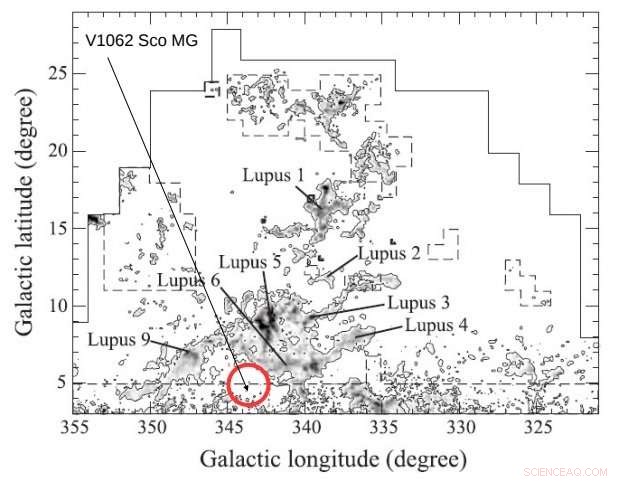
The location of the V1062 Sco Moving Group (red circle). Credit: Röser et al., 2017.
A team of astronomers from Germany and Hungary has detected a new group of co-moving young stars. The newly found group is located in the Upper Centaurus Lupus (UCL) section of the Scorpius–Centaurus Association. The finding is reported in a paper published December 29 on the arXiv pre-print repository.
The Scorpius–Centaurus Association (Sco-Cen) is an association of massive young stars of spectral type O and B. Located at a mean distance of 400 light years away from the Earth, it is the nearest region of recent massive star formation.
One of its subgroups is the UCL, which is almost entirely covered by star-forming regions, except for a small area in the south-eastern corner of this subgroup. Now, a group of researchers led by Siegfried Röser of the Heidelberg University in Germany, has found a compact, young moving group of stars in this particular area of UCL.
The newly detected group, named V1062 Sco Moving Group (V1062 Sco MG for short), was found by analyzing the data available in the Gaia-TGAS proper motion catalog in late 2016. Next, the researchers conducted follow-up observations of V1062 Sco MG using the FEROS instrument at the MPG/ESO 2.2 m Telescope in La Silla, Chile, in order to confirm the discovery and with the aim of determining fundamental parameters of this group.
"We detected a hitherto unknown moving group or cluster in the Upper Centaurus Lupus section of the Sco-Cen OB-association," the scientists wrote in the paper.
According to the study, V1062 Sco MG is a co-moving group of 63 young stars at the edge of the UCL section, some 570 light years away from the Earth.
"Altogether, we found 12 members with confirmed radial velocities and parallaxes, 31 with parallaxes or radial velocities, and 20 candidates from the convergent point method," the paper reads.
However, although the stars of this group are generally young, they are not coeval, as their ages range from four to 25 million years. At the moment, the researchers cannot explain this age spread.
The authors of the paper emphasized that the newly found group is strongly co-moving and its one-dimensional velocity dispersion is less than 1.0 km/s. When it comes to the masses of the members of the group, they range from 0.7 to 2.6 solar masses.
Although the researchers identified dozens of members of V1062 Sco MG, still many stars of this group remain undetected. The authors of the study believe that the Gaia Data Release 2 (from ESA's Gaia satellite), expected to be published in April 2018, will reveal new and fainter members of the group. Further studies of V1062 Sco MG and other co-moving groups could provide important information about the process of star formation in associations.
© 2018 Phys.org