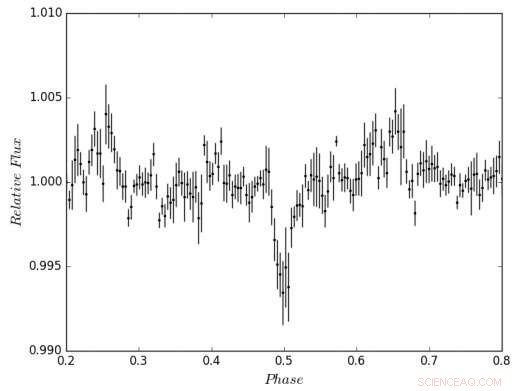
The discovery light curve for Qatar-6b phase folded with the BLS estimated period, as it appears in the QES archive. Credit: Alsubai et al., 2017.
(Phys.org)—An international group of astronomers has found a new grazing transiting "hot Jupiter" alien world as part of the Qatar Exoplanet Survey (QES). The newly discovered extrasolar planet, designated Qatar-6b, is about the size of Jupiter, but less massive than our solar system's gas giant. The finding is reported in a paper published December 8 on arXiv.org.
Although astronomers have found hundreds of exoplanets, only a handful of grazing alien worlds—meaning planets that partially transit the host-star's disc—have been detected so far. Such planets are important for researchers, as they offer a great opportunity to find additional bodies orbiting their host stars. This is because other as-yet undetected objects would perturb the grazing planet's orbit and could potentially induce periodic variations of the transit impact parameter, leading to transit duration variations.
Now, a team of astronomers, led by Khalid Alsubai of the Qatar Environment and Energy Research Institute (QEERI) in Doha, Qatar, reports the finding of a new addition to the short list of planets in a grazing transit configuration. They discovered Qatar-6b as part of the QES survey, which utilizes the New Mexico Skies Observatory located at Mayhill, New Mexico.
"In this paper, we present the discovery of Qatar-6b, a newly found hot Jupiter on a grazing transit," the researchers wrote in the paper.
According to the study, Qatar-6b has a radius about 6 percent larger than Jupiter and a mass of approximately 0.67 Jupiter masses, which indicates a density of 0.68 g/cm3. The exoplanet orbits its parent star every 3.5 days at a distance of about 0.04 AU from the host. Due to the proximity of this planet to the star, astronomers estimate that it has an equilibrium temperature of 1,006 K.
The parameters suggest that Qatar-6b belongs to group of planets known as "hot Jupiters." These exoworlds are similar in characteristics to the solar system's biggest planet, with orbital periods of less than 10 days. They have high surface temperatures, as they orbit their host stars very closely.
The host, designated Qatar-6 (also known as TYC 1484-434-1 or 2MASS J14485047+2209093), is a high proper motion star of spectral type close to K2V, located some 330 light years away from the Earth. It has a radius of about 0.72 solar radii and is approximately 18 percent less massive than the sun. The study reveals that the star is about 1 billion years old, and has an effective temperature of 5,052 K.
Given that Qatar-6b is a grazing exoplanet, is an excellent target for future observational campaign aiming to find additional bodies in this planetary system. These observations, utilizing large ground-based facilities or space telescope, should be focused on detecting variations in the transit impact parameter and duration.
"These would require high cadence and high photometric accuracy observations that could be achieved with large ground based telescopes and/or space based facilities," Alsubai's team concluded.
© 2017 Phys.org