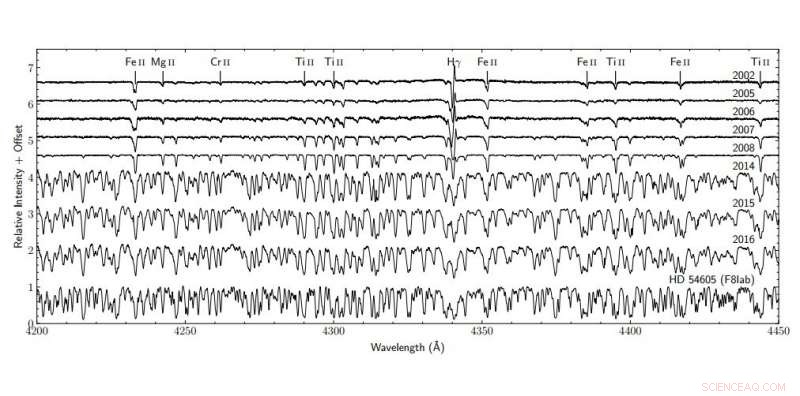
Spectral variation of R 40 seen in the spectra taken from 2002 (top) until 2016 (bottom). We can see the change from a late B/early A-type to a late F-type spectrum, implying a new eruption. The spectrum of HD 54605 (F8Ia) is also shown for comparison. Credit: Campagnolo et al., 2017.
(Phys.org)—Astronomers report the detection of new eruptions in two luminous blue variables, known as R 40 and R 110, located in the Magellanic Clouds. The finding, presented December 5 in a paper published on the arXiv pre-print repository, could shed new light on the final phases of stellar evolution process.
Luminous blue variables (LBVs), also known as S Doradus variables (after S Doradus, one of the brightest stars of the Large Magellanic Cloud), are rare and unstable massive evolved stars exhibiting strong photometric and spectroscopic variability related to transient eruptions. So far, only about 40 LBVs are known in our Milky Way galaxy and in the galaxies of the Local Group.
However, the cause of eruptions in LBVs is not fully understood and is still debated. Astronomers suppose that such eruptions could be caused by high rotation, radiative pressure, turbulent pressure, internal dynamic mechanisms, binarity, or they could be triggered by a combination of some of these mechanisms. Spotting new eruptions could help determine the exact cause, which could improve our understanding of stellar evolution of massive stars.
Now, a group of astronomers led by Julio Campagnolo of the National Observatory in Rio de Janeiro, Brazil, has observed new eruptions in two LVBs, designated R 40 and R 110. R 40 (also known as RMC 40), located in the Small Magellanic Cloud. They are about 280 times larger than the sun, with a mass of approximately 16 solar masses. When it comes to R 110 (or RMC 110), residing in Large Magellanic Cloud, it has a radius of more than 300 solar radii and is ten times more massive than the sun.
Campagnolo's team conducted high-resolution spectroscopic observations of R 40 and R 110 using the Fiber-fed Extended Range Optical Spectrograph (FEROS) mounted at 2.2 m ESO-MPI telecope at La Silla Observatory (Chile) and photometric observations of these two LVBs by utilizing the 0.6 m telescope Boller & Chivens at the Pico dos Dias Observatory in Brazil.
"In this paper, we present the detection of new eruptions for two LBVs in the Magellanic Clouds R 40 and R 110, based on new spectroscopic and photometric data," the researchers wrote in the paper.
According to the study, both LBVs experience ongoing eruptions. In R 40, the astronomers detected a strong eruption that reached a V magnitude of 9.2 in 2016, which is around 1.3 mag brighter than the minimum registered in 1985 and also much stronger than the previous eruption recorded in 1996. As a result of the new eruption, the effective temperature of R 40 dropped to about 6,100 K, what made it one of the coolest LBVs known to date.
Contrary to R 40, R 110 is now passing through a weak eruption, with a maximum V magnitude of 9.9 mag in 2011. The new eruption is weaker than the previous one in 1994 and about 0.2 mag fainter than the first such event detected in this star in 1990. Due to the new eruption, the effective temperature of R 110 dropped to about 8,500 K.
In concluding remarks the astronomers noted that still more observations are necessary in order to determine the periodicity of the eruptions in R 40 and R 110. They call for more comprehensive observational campaign that could uncover more insights into such events in these two LBVs.
"As for each star just two eruptions have been recorded, it is not possible to derive a periodicity for these events. Thus, an observational campaign, associated with photometry, spectropolarimetry and high-resolution spectroscopy, covering not only the V band but also other bands is definitely necessary to follow up these eruptions and better derive their characteristics, and also identify new eruptions," the authors concluded.
© 2017 Phys.org