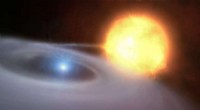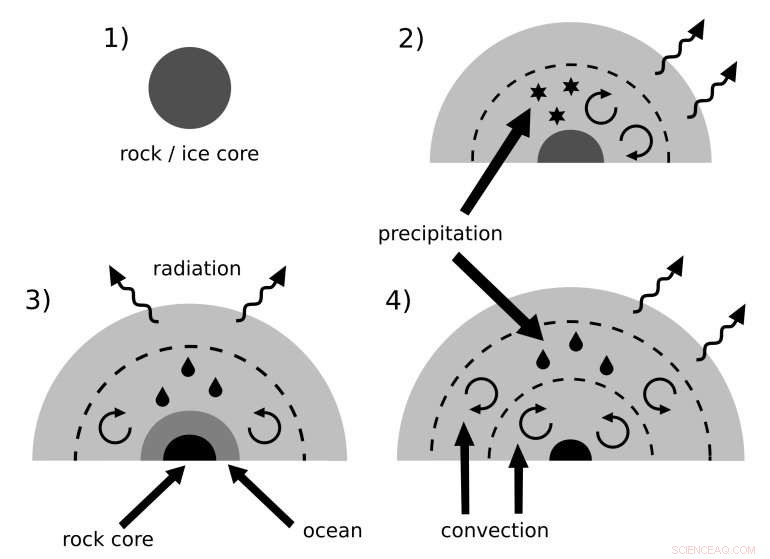
Schematic diagram showing several evolutionary stages of a protoplanet accreting ice-rich pebbles. (1) Planet without an atmosphere. (2) Planet with an atmosphere and a solid ice/rock surface. The outer atmosphere is radiative. The inner atmosphere is convective with ice grains precipitating towards the surface. (3) Planet with a rocky core and an ocean. The outer atmosphere is radiative, and the inner atmosphere is convective with ice and water precipitation. (4) Planet with a rock core and no ocean. The outer atmosphere is radiative, and the inner atmosphere is convective. Precipitation occurs at mid altitudes, but the deep atmosphere is too hot for water to condense or undersaturated. Credit: arXiv:1710.03134 [astro-ph.EP]
(Phys.org)—John Chambers, a planetary scientist with the Department of Terrestrial Magnetism at Carnegie Institution has suggested a new theory regarding the formation of gas giant planets. In his paper uploaded to the preprint server arXiv, soon to be published in the Astrophysical Journal, he describes his theory and its possible implications.
The origins of gas giants such as Jupiter are believed to be similar to those of rocky planets—via accretion of material circling their star. It is believed they become gas giants due to their distance from their star and the limited impact of stellar winds. In this new effort, Chambers offers a new, more detailed theoretical description of the process.
Chambers suggests that accretion from rocks as small as pebbles and ice could have led to the formation of a protoplanet with slowly increasing atmospheric pressure—that, he says, would have caused the ice to sublimate, filling the atmosphere with water particles—he describes it as a steamy world. As time passes, heat from the star would cause the protoplanet to grow warmer and gain more mass, and the atmospheric pressure to rise, which in turn would allow the atmosphere to hold even more water. At some point, he notes, the pressure would become so great that the water would become a supercritical fluid—a mix of hydrogen and helium. That, he suggests, would lead to a runaway situation in which the protoplanet begins pulling in gasses from the disk around its star—continually growing until it depletes available gas, reaching its ultimate size.
This new theory by Chambers notably differs from other theories that suggest that planets tend to form from large, kilometer-sized chunks of space debris. But it does conform to another theory that suggests that gas giants must form relatively quickly because stellar winds thin dramatically as the star ages.
Chambers notes that even if his theory is correct, he is still not sure if it would apply to Jupiter, though there is some recent evidence suggesting that the gas giant has a core that is more diffuse than has been generally thought.
© 2017 Phys.org