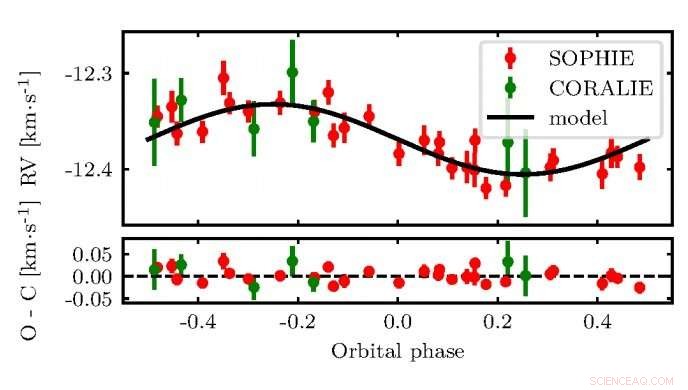
Radial velocities of WASP-151. The data points are represented with their associated 1σ error bars. Credit: Demangeon et al., 2017.
(Phys.org)—A team of European astronomers has detected three new gas giant alien worlds as part of the SuperWASP exoplanet-hunting survey. Two of the newly found planets are the so-called "hot Saturns," while the third one was classified as a "super-Neptune." The discovery was reported October 17 in a paper published on arXiv.org.
WASP, short for Wide Angle Search for Planets, is an international consortium conducting an ultra-wide-angle search for exoplanets using the transit photometry method. The SuperWASP program employs two robotic observatories: SuperWASP-North at the Roque de los Muchachos Observatory in Canary Island, Spain, and SuperWASP-South, at the South African Astronomical Observatory, located near Sutherland, South Africa. These observatories are equipped with eight wide-angle cameras that simultaneously monitor the sky for planetary transit events, which allows monitoring of millions of stars at the same time.
Recently, a group of researchers led by Olivier D. S. Demangeon of the University of Porto in Portugal reported another discovery under the SuperWASP program. The team found transit signals from three stars, namely WASP-151, WASP-153 and WASP-156. The planetary nature of these signals was later confirmed by follow-up observations using the SOPHIE spectrograph at the 1.93-m telescope of the Haute-Provence Observatory, France, and the CORALIE spectrograph at the 1.2-m Euler-Swiss telescope at La Silla Observatory in Chile.
"In this paper, we report the discovery of three transiting exoplanets by the SuperWASP survey and the SOPHIE spectrograph with mass and radius determined with a precision better than 15 percent," the astronomers wrote in the paper.
The largest and most massive planet of the newly found trio is WASP-153b with a radius of about 1.55 Jupiter radii and a mass of 0.39 Jupiter masses. It orbits its parent star every 3.33 days and has an equilibrium temperature of 1,701 K.
WASP-151b is about 13 percent larger than Jupiter and has a mass of approximately 0.31 Jupiter masses. The planet has an equilibrium temperature of 1,291 K and an orbital period of 4.53 days.
Both WASP-151b and WASP-153b are low-density gaseous planets orbiting early G-type stars. The two exoplanets were classified as "hot Saturns" due to the fact that they have masses close to Saturn's and have high surface temperatures as they circle their hosts very closely.
When it comes to WASP-156b, it is half the size of Jupiter and has a mass of approximately 0.13 Jupiter masses. It has an equilibrium temperature of 1,291 K and orbits a K-type host every 3.83 days. Given that this planet is about 2.5 times more massive than Neptune and taking into account its surface temperature, it was classified by researchers as a "super-Neptune."
The authors of the study concluded that the newly found alien worlds could helps us better understand the so-called Neptunian desert - a depletion of exoplanets at short orbital periods (below 10 days) with masses or radius between "super-Earth" and subjovian planets. For instance, WASP-156b is only the ninth "super-Neptune" detected so far.
"These three planets also lie close to (WASP-151b and WASP-153b) or below (WASP-156b) the upper boundary of the Neptunian desert. (…) While a detailed analysis of the origin of the Neptunian desert is beyond the scope of this paper, it is still interesting to look into the similarities and differences between WASP-156b and WASP- 151b/WASP-153b since they might provide useful hints on the nature of this desert," the paper reads.
© 2017 Phys.org