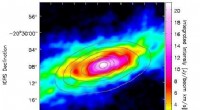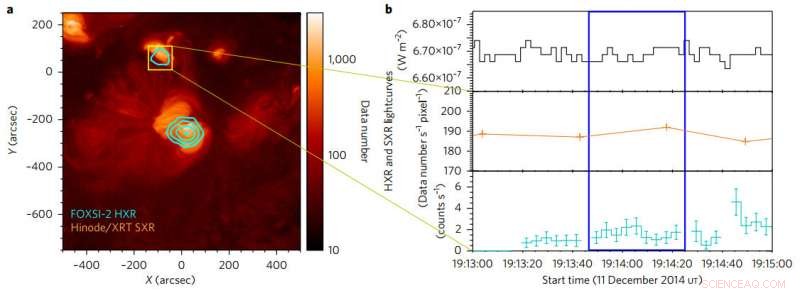
Image and lightcurves of the HXR and SXR emissions. a, HXR (above ~3 keV) emission observed by FOXSI-2 on 11 December 2014, 19:13:47–19:14:25 ut (cyan contours) overlaid on SXR (below ~3 keV) images (see colour scale) of two active regions taken with Hinode/XRT (sensitive to >2 MK). Active region 12234, shown in the yellow box, exhibited no individual flaring activity during the time interval, and was selected for the analysis. b, GOES/XRS (top), Hinode/XRT (middle) and FOXSI-2 (bottom) lightcurves. The GOES lightcurve is for the full Sun, and the XRT and FOXSI lightcurves are for 12234. The error bars in the FOXSI-2 lightcurve show 1σ standard deviation statistical errors. The gaps in the FOXSI-2 lightcurve show the intervals for pointing changes. The blue box shows the integration time for the FOXSI-2 image in a. Credit: Nature Astronomy (2017). DOI: 10.1038/s41550-017-0269-z
(Phys.org)—A team of researchers from the U.S., Japan and Switzerland has found possible evidence of a source of energy that could be responsible for heating the sun's corona. In their paper published in the journal Nature Astronomy, the researchers describe studying data from the FOXSI-2 sounding rocket and what it revealed.
One of the interesting problems in space research is explaining why the sun's atmosphere (its corona) is so much hotter than its surface. The chief problem standing in the way of an answer is the lack of suitable instruments for measuring what occurs on the sun's surface and its atmosphere. In this new effort, the researchers used data from the FOXSI-2 sounding rocket (a rocket payload carrying seven telescopes designed to study the sun) to test a theory that suggests heat is injected into the atmosphere by multiple tiny explosions (very small solar flares) on the surface of the sun. Such flares are too small to see with most observational equipment, so the idea has remained just a theory. But now, the new data offers some evidence suggesting the theory is correct.
To test the theory, the researchers looked at X-ray emissions from the corona and found some that were very energetic. This is significant, because solar flares emit X-rays. But the team was studying a part of the sun that had no visible solar flares occurring at the time. This, of course, hinted at another source. The research team suggests the only likely source is superheated plasma that could only have occurred due to nanoflares.
The researchers acknowledge that their findings do not yet solve the coronal heating problem, but they believe they might be getting close. They note that much more research is required—next year, they point out, another sounding rocket will be launched with equipment even more sensitive than that used in the last round, offering better detection of faint X-rays. Also, plans are underway to launch a satellite capable of detecting nanoflares. If future tests can clearly identify the source of the X-rays, the coronal problem may soon be resolved.
© 2017 Phys.org