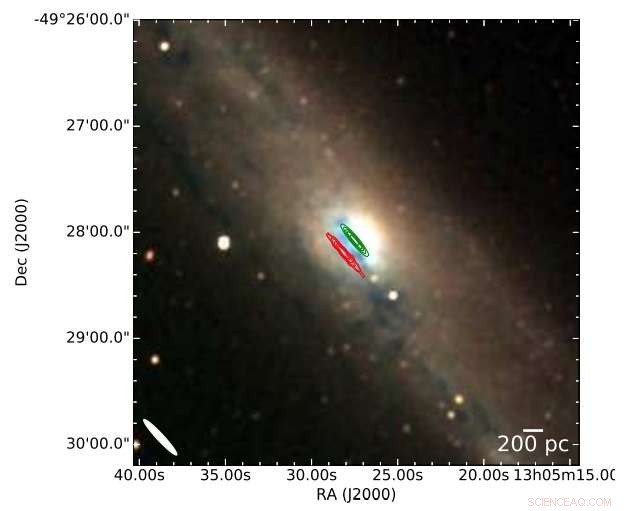
36.2 GHz emission methanol emission and the 7 mm continuum emission with background 2MASS 3 colour image. Credit: McCarthy et al., 2017.
(Phys.org)—Using the Australia Telescope Compact Array (ATCA), a team of astronomers has detected methanol emission toward a nearby galaxy known as NGC 4945. The finding, reported Aug. 18 in a paper published on arXiv.org, could be helpful in improving our understanding of star formation processes.
Maser lines of methanol are commonly detected toward regions of high-mass star formation. They are very widespread in our Milky Way galaxy, as they have been detected in more than 1200 sources in the galaxy to date. Due to their rich spectrum of masing transitions, they could be used as a powerful tool for probing star formation regions.
Scientists divide methanol masers into two groups: class I and class II. Class I masers are associated with the interaction of shocked gas with molecular clouds, driven by outflows or expanding H II regions, while class II masers are closely associated with young stellar objects.
Now, a team of researchers led by Tiege McCarthy of the University of Tasmania in Hobart, Australia, reports the finding of a new class I methanol maser beyond the Milky Way, toward NGC 4945. Located nearly 12 million light years away from the Earth, NGC 4945 is a barred spiral galaxy in the constellation Centaurus, and one of the brightest galaxies of the Centaurus A/M83 Group (large, nearby group of galaxies).
"Here, we report a search for the class I 36.2 GHz and class II 37.7 GHz transition towards the central region of NGC 4945. (…) We detected emission from the 36.2 GHz methanol transition as well as 7 mm continuum emission towards NGC4945," the astronomers wrote in the paper.
The observations leading to the discovery were conducted in August 2015, using ATCA's EW352 array, with minimum and maximum baselines of 31 and 352 meters resulting in a synthesised beam at 36.2 GHz.
The researchers detected a region of 36.2 GHz methanol emission offset southeast from the galactic nucleus by 567 light years. The newly found emission is narrow, with a linewidth below 10 km s−1, and the scientists assume that it may be associated with molecular inflow, which is observed in HF absorption.
The study reveals that this emission's luminosity is five orders of magnitude higher than galactic class I masers from the same transition and 90 times more luminous than the widespread emission detected from our galaxy's central molecular zone. The authors emphasized that their discovery marks the third time when the 36.2 GHz methanol transition has been observed in an extragalactic source. Moreover, it is also the fourth detection of extragalactic class I emission so far.
The scientists hope that more subsequent observations of such phenomena like methanol masers will help create a better database that could be very useful for studies on star formation processes. "As our sample size increases, it will become easier to identify factors that make galaxies appropriate hosts for class I methanol masers, and allow higher success rates in targeted searches," the team concluded.
© 2017 Phys.org