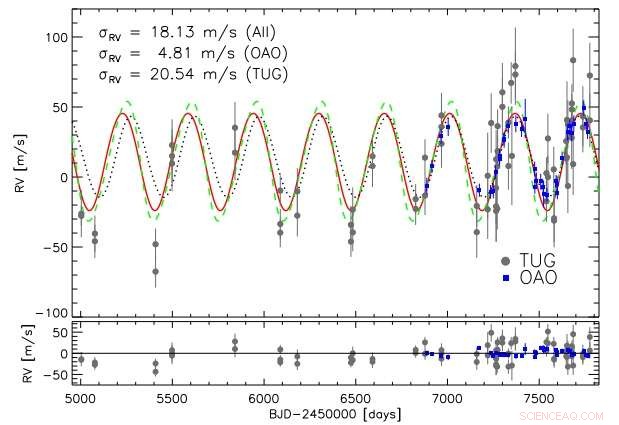
Observed RV variations and the best-fit orbital solutions of HD 208897 with its residuals (bottom) to the best-fit-model. The solid red, dotted, and green dashed lines indicate the best Keplerian fit for TUG+OAO, OAO, and TUG, respectively. Dark gray points and blue squares represent data from TUG and OAO, respectively. Credit: Yilmaz et al., 2017.
(Phys.org)—An international team of astronomers has discovered a Jupiter-mass alien world circling a giant star known as HD 208897. The newly detected exoplanet was found as a result of high-precision radial velocity measurements. The discovery was detailed in a paper published Aug. 6 on the arXiv preprint server.
HD 208897 is a giant star of spectral type K0, located some 210 light years away from the Earth. It is about five times larger than our sun and has a mass of approximately 1.25 solar masses. The star is metal rich and at the early phase of ascent along the red giant branch. "Our stellar parameters indicate that HD 208897 is a metal-rich star that is at the base of RGB phase," the scientists wrote in the paper.
HD 208897 was one of the targets of an extensive observational campaign carried out from 2007 to 2017, the main goal of which is to search for substellar companions and planets around 50 evolved G and K-type stars. As a result of this survey, a group of researchers led by Mesut Yilmaz of the Ankara University, Turkey, found that 13 of the targets, including HD 208897, show significant radial velocity variations.
The researchers acquired 73 spectra of HD 208897 using the Coude Echelle Spectrograph (CES) installed on the 1.5-meter Russian-Turkish Telescope (RTT150) at TÜBİTAK National Observatory (TUG) in Antalya, Turkey. They also conducted follow-up spectroscopic observations of this star with the 1.88-meter telescope and the High Dispersion Echelle Spectrograph (HIDES) high-efficiency fiberfeeding system (HIDES-F) at the Okayama Astrophysical Observatory (OAO) in Japan. Moreover, the team observed the star photometrically at the Ankara University Kreiken Observatory (AUKR) to check photometric variability or detect any transit phenomena.
The long-lasting observational campaign allowed the astronomers to find a periodic signal, suggesting the presence of an unseen and probably low-mass companion of HD 208897.
"In this work, we report the first planet discovery around a giant star HD 208897 in our planet search program using the RTT150 and 1.88 m telescope at OAO," the paper reads.
The researchers revealed that the newly found planet has a minimum mass of 1.4 Jupiter masses. It is located at a distance of about 1.05 AU from the star and circles its host every 353 days. Notably, the extrasolar world has a nearly circular orbit.
According to the authors of the paper, their study demonstrates that it is possible to detect such lower mass planets in the range of Jupiter, even around giant stars, if long-term observations are carried out. They also emphasize the importance of the finding for our understanding of planet formation scenarios.
"This discovery will be important in understanding the planet formation around metal-rich intermediate-mass stars and the effect of stellar evolution on the planetary system configuration," the researchers concluded.
© 2017 Phys.org