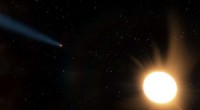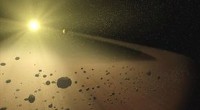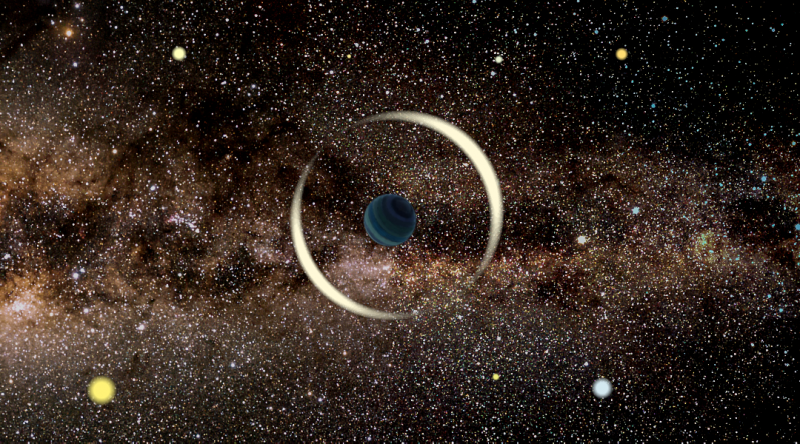
An artist's impression of a gravitational microlensing event by a free-floating planet. Credit: J. Skowron / Warsaw University Observatory
(Phys.org)—A team of researchers with Warsaw University Observatory, Ohio State University and the University of Warwick has found evidence that suggests there are far fewer Jupiter-sized rogue planets roaming the Milky Way galaxy than prior surveys have shown. In their paper published in the journal Nature, the group describes using data compiled from the Optical Gravitational Lensing Experiment to analyze light curves of approximately 50 million stars for the period 2010 to 2015 and what they found by doing so.
Back in 2011, an international team of researchers conducted a study of rogue planets and reported evidence suggesting that there are approximately twice as many rogue Jupiters as main sequence stars. In this new effort, the researchers took a new census gain a more accurate estimate.
Identifying rogue planets is difficult, of course, because they do not emit any light of their own—against the black of space, there is nothing to see. But when they move past light emitted from a distant star, a lensing phenomenon can occur. This happens when light from the blocked star is magnified by the planet's gravity, causing a lensing halo effect that can be seen by instruments here on Earth. The size of the planet can also be calculated by noting the lensing duration. The researchers with this new census winnowed down the millions of stars in the dataset to just 2,617 high-quality microlensing events. This represented a much larger sample size than the one used by the team in 2011—they analyzed just 474 events.
The researchers conclude that Jupiter-sized rogue planets are far rarer than the earlier census claimed. But they note it is possible that are more Earth-sized rogue planets roaming around than currently believed. The data also showed that of the big rogue planets roaming the Milky Way, approximately 25 percent of them are likely gas giants, with the remaining 75 percent represented by rocky or ice giants.
The researchers conclude by suggesting their findings jibe with logic—there are likely to be fewer rogue giant planets because they would have a stronger gravitational connection to their original star system. Smaller, Earth-like planets, on the other hand, could be flung off with relative ease.
© 2017 Phys.org