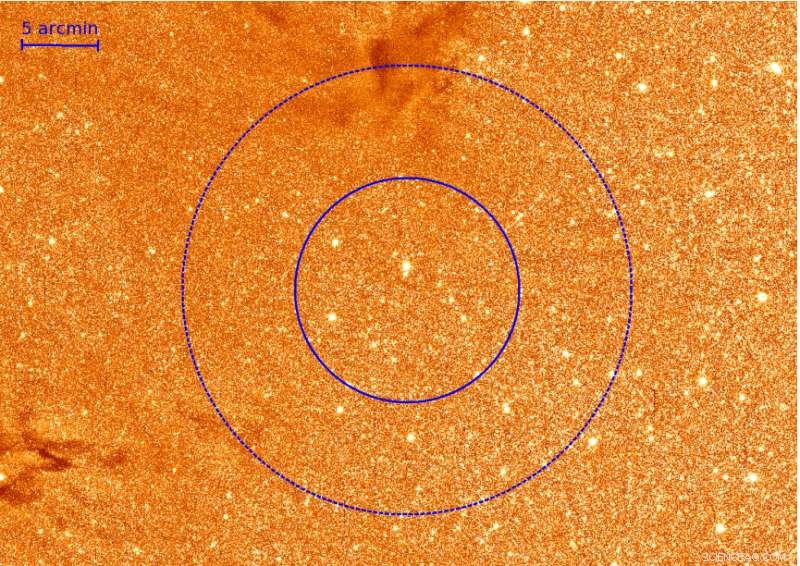
DECam VR-band image of the FRB 150215 field. The blue circles represent the Parkes radio telescope beam (7.50', inner, solid line) and extended (15.00', outer, dashed line) positional error. The circles are centered on the pointing of the Parkes beam upon detection of FRB 150215. No transient event was found in the i-band stacked images within the region. Credit: arXiv:1705.02911 [astro-ph.HE]
(Phys.org)—An international team of space researchers has reported on the detection of a new fast radio burst (FRB) and their efforts to trace its source. They have written a paper describing the detection and search for evidence, and have uploaded it to the arXiv preprint server.
FRBs are a relatively new development for space scientists—they are extremely short blasts of strong radio waves that come from space, but scientists have not been able to explain what makes them. In this new detection, the FRB, now named FRB 150215, was first detected by researchers working with the Parkes Telescope in New South Wales, Australia. What made the detection of FRB 150215 unique was that several teams were prepared to train their telescopes on the FRB origin point shortly after it was detected. Unfortunately, none of them were able to detect anything that might identify its cause, or even exactly where it occurred. exactly. Additionally, after analyzing data from the follow-up telescopes, the researchers found that the FRB had taken an interesting path through the Milky Way to make its way to us—a hole of sorts that, prior to the detection of the FRB, was unknown. Thus, despite learning nothing new about the source of FRBs in general, the team has learned something new about our galaxy.
The detection of FRB 150215 marks the detection of 22 FRBs to date, none of which have identifiable sources, making them one of the great mysteries of space science. Common sense suggests that finding a source should be relatively easy—it would take something pretty big to create such strong pulses of radio waves. The mysterious nature of FRBs has led to a host of theories regarding their nature, from supernova to intelligent alien communications. Others suggest the research into finding the source of FRBs has been unsuccessful because space scientists are looking at the problem backwards—FRBs, they note, could arise long after the precipitating event. That means it might make more sense to look for noticeable events in the night sky, like supernovas, and then monitor for FRBs sometime later.
In any event, study of FRBs is likely to increase as the mystery deepens and new telescope technology emerges—some have even suggested that it is possible that FRBs are much more common than has been shown, and that once they are observed more regularly, researchers can focus on looking at patterns.
© 2017 Phys.org