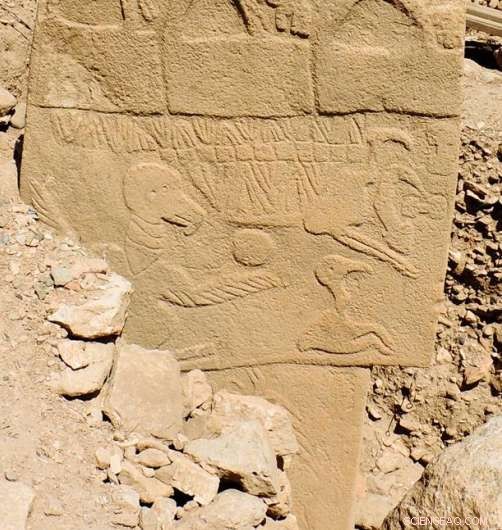
Pillar 43, Enclosure D, also known as the Vulture Stone of Göbekli Tepe. Credit: Martin B. Sweatman and Dimitrios Tsikritsis
(Phys.org)—A team of researchers with the University of Edinburgh has found what they describe as evidence of a comet striking the Earth at approximately the same time as the onset of the Younger Dryas in carvings on an ancient stone pillar in southern Turkey. The group has published their findings in the journal Mediterranean Archaeology and Archaeometry.
Prior evidence based on ice cores taken from Greenland has suggested that a strike by a comet may have led to the onset of the Younger Dryas—a period of Earth cooling that lasted for approximately 1000 years. Other evidence also suggests that the cooling period caused groups of people to band together to cultivate crops, leading to the development of agriculture, which in turn led to huge leaps in technological innovations and societal developments, i.e. Neolithic civilization. In this new effort, the researchers describe evidence they found on a stone pillar at Gobekli Tepe (the oldest known temple site) that aligns with the ice core findings—that a comet struck the Earth in approximately 10,950BC.
The pillar was created by the people of Gobekli Tepe and now appears to have served as a means of commemorating a devastating event—perhaps a comet breaking up and its remnants crashing into the Earth, causing an immediate environmental impact around the globe and possible loss of life (one of the characters on the pillar was of a headless human.) The team fed likenesses of the images carved onto the pillar (known as the vulture stone) into a computer to determine if they might be linked with constellations. Doing so revealed associations between characters on the pillar and astronomical symbols in the sky for the year 10,950 BC. The fact that the people took the time and considerable effort to create the characters on the pillar suggests something very important must have happened during the same time period that the Greenland ice core suggests a comet struck, approximately 10,890BC.
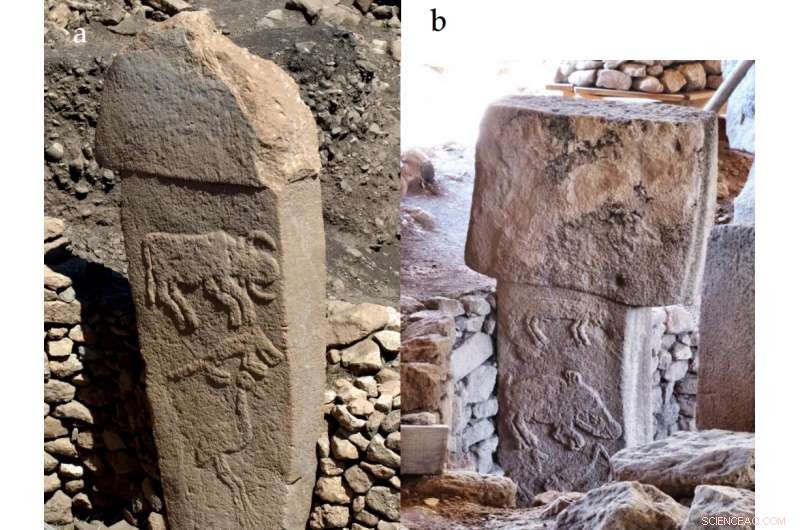
Wall pillars with three animal symbols in series. Part a) is pillar 2 from Enclosure A, while part b) is pillar 38, Enclosure D (images courtesy of Travel The Unknown).
The researchers have concluded that the carvings on the pillar were likely meant to document the cataclysmic event and suggest that the temple may have been an observatory. They also report that they found evidence of changes to the Earth's rotational axis as a result of the comet strike.
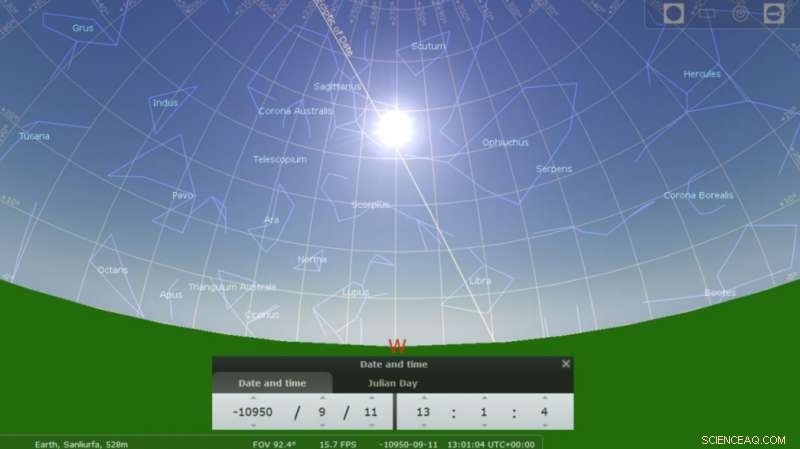
Constellations around Scorpius (Western Lore). Credit: B. Sweatman, D. Tsikritsis
© 2017 Phys.org