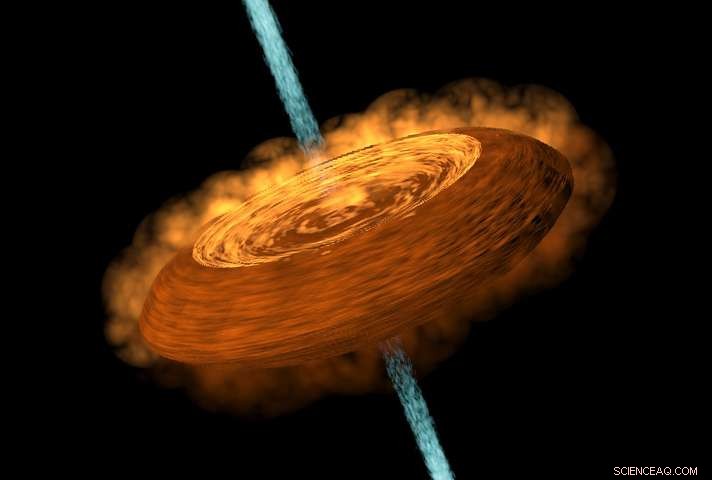
An illustration of an accretion disk feeding a central young star, or protostar, and the gaseous jet ejected from the protostar. Credit: Yin-Chih Tsai/ASIAA
(Phys.org)—A team of researchers from the U.S. and Taiwan has captured the first clear image of a young star surrounded by an accretion disk. In their paper published in the journal Science Advances, the team describes how the image was captured and details of their find.
Astrophysics have theorized that accretion disks form around young stars acting as food, helping the young star to grow bigger. Such an accretion disk would also make up the material that would over time accrete into planets. But until now, no clear image of an accretion disk had been made because the technology to do so did not exist. Now, thanks to hard work by the team and the ALMA radio telescope in Chile, that has changed.
ALMA came online just four years ago—at a cost of $1.4 billion, it holds the record for the most expensive radio telescope ever built. But it also offers unprecedented resolution, capturing images in sharp detail that have appeared as fuzzy blobs in prior images. That resolution allowed the researchers to zoom in on a young star named IRAS 05413-0104 (part of the HH212 system and believed to be just 40,000 years old) that had around it a rotating accretion disk. Such disks are believed to be made of matter such as silicate, iron and other interstellar matter, and provide a steady source of food for the star. And because the disks are triple layered with brighter outer layers, the researchers describe it as looking like a hamburger.
The captured image lays to rest one critique of the prediction of accretion disks around young stars, which was that the magnetic field from the core of the star would be so strong that it would prevent the accretion disk from spinning, thus preventing its ability to gather matter. That is clearly not the case, as the new image shows. Also seen in the image were gaseous jets ejected from the star, which appear to pierce the hamburger at its center.
It is believed that more information about the formation of stars will contribute to understanding both the history of our sun and how planets form, perhaps offering a better way of filtering star systems while searching for signs of life beyond our own planet.
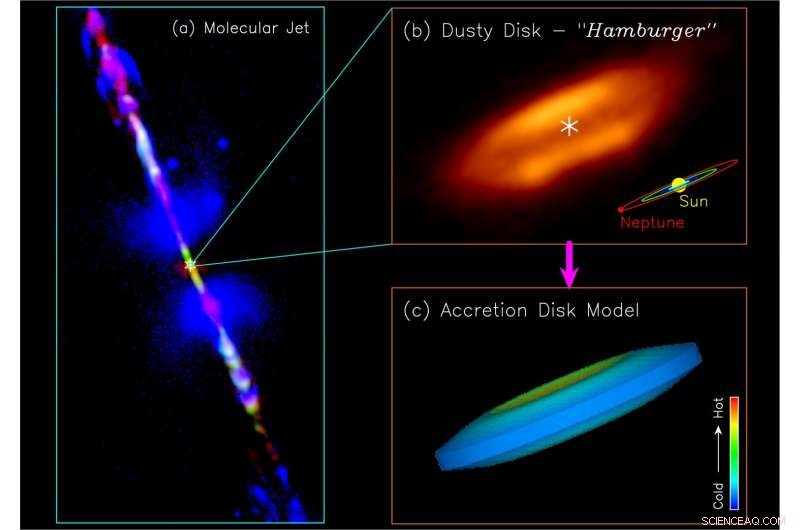
Jet and disk in the HH 212 protostellar system: (a) A composite image of the jet, produced by combining images from different telescopes. The orange image around the center shows the accretion disk at 200 AU resolution. (b) Close-up of the center of the dusty disk at 8 AU resolution. Asterisks mark the possible position of the central protostar. A dark lane is seen in the equator. Our solar system is shown in the lower right corner for size comparison. (c) An accretion disk model that can reproduce the observed dust emission in the disk. Credit: ALMA (ESO/NAOJ/NRAO)/Lee et al.
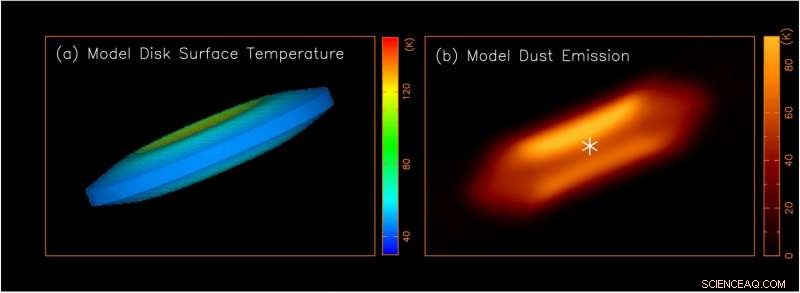
(a) The accretion disk model with the disk surface temperature. (b) The model dust emission map derived from the disk model. This model map is roughly the same as the observed map of the disk. Credit: Lee et al.
© 2017 Phys.org