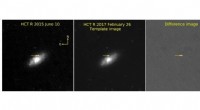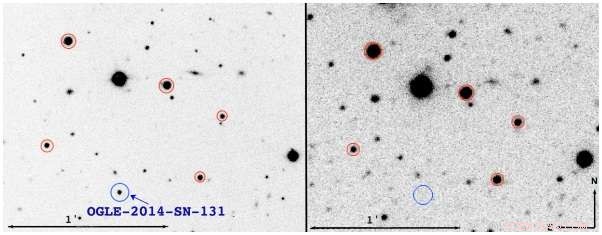
Left: OGLE-2014-SN-131 (blue circle) in a VLT acquisition image taken with an R−special filter on November 29.1, 2014 (JD 2456990.08). Right: NTT image from August 1.2, 2016 (JD 2457601.74), showing no visible host at the SN location. Credit: Karamehmetoglu et al., 2017.
(Phys.org)—An international team of astronomers has detected a new slowly evolving Type Ibn supernova as part of the Optical Gravitational Lensing Experiment (OGLE). The new event, designated OGLE-2014-SN-131, has the longest rise time ever observed in Type Ibn supernovae. The discovery is described in a paper published Mar. 23 on the arXiv pre-print server.
Type Ibn supernovae are explosions whose spectra are characterized by low-velocity helium emission lines. They are thought to be the core-collapse explosions of massive stars whose ejecta interact with helium-rich circumstellar material. They have also relatively high peak luminosities and are blue at peak.
Type Ibn supernovae are usually fast evolving with a short rise to peak brightness (less than two weeks) and a subsequent fast decline. However, a group of researchers led by Emir Karamehmetoglu of the Stockholm University in Sweden has found a new Type Ibn supernova that exhibits an unprecedentedly long rise time and a much broader light curve compared to other supernovae in this class.
Karamehmetoglu's team discovered OGLE-2014-SN-131 on November 11, 2014 using the OGLE-IV Transient Detection System. Afterward, the researchers conducted follow-up photometric observations of this supernova with the OGLE telescope at the Las Campanas Observatory in Chile and with the Gamma-Ray Burst Optical/Near-Infrared Detector (GROND) mounted on the 2.2m MPG/ESO telescope at La Silla, also in Chile. Moreover, they performed spectroscopic observations of OGLE-2014-SN-131 with the ESO New Technology Telescope (NTT) at La Silla and with the Very Large Telescope (VLT) at Cerro Paranal in Chile.
These observations show that OGLE-2014-SN-131 spectroscopically resembles other Type Ibn supernovae such as SN 2010al and showcases also peak luminosity and post-peak colors similar to other events in this class. Notably, however, the light curve of OGLE-2014-SN-131 is broader and longer-rising than any other Type Ibn supernova.
"Spectroscopy and multi-band photometry of OGLE14-131 have been presented. Identification of prominent He I emission lines classifies this SN as a Type Ibn. While, spectroscopically, OGLE14-131 is identified as a normal SN Ibn, when compared to other Type Ibn SNe, its broad light curve shows the longest rise time ever observed for this SN class," the authors write.
The researchers try to explain this record-long rise time, noting that it requires higher ejecta and circumstellar material masses for the progenitor when compared to typical supernova Ibn progenitors. Therefore, they concluded that the most likely progenitor scenario for OGLE-2014-SN-131 is a massive Wolf–Rayet star.
"To explain the unusually long rise time, the broad light curve, the light curve decline, and the spectra characterized by narrow emission lines, we favor a powering mechanism where the SN ejecta are interacting with a dense curcumstellar material. The progenitor of OGLE-2014-SN-131 was likely a Wolf-Rayet star with a mass greater than that of a typical SN Ibn progenitor, which expelled the circumstellar material that the SN is interacting with," the team wrote in the paper.
The astronomers added that given the fact that OGLE-2014-SN-131 has an unusually massive progenitor for a Type Ibn supernova, we should expect a low number of similar slowly evolving events as such massive stars should be relatively rare.
© 2017 Phys.org