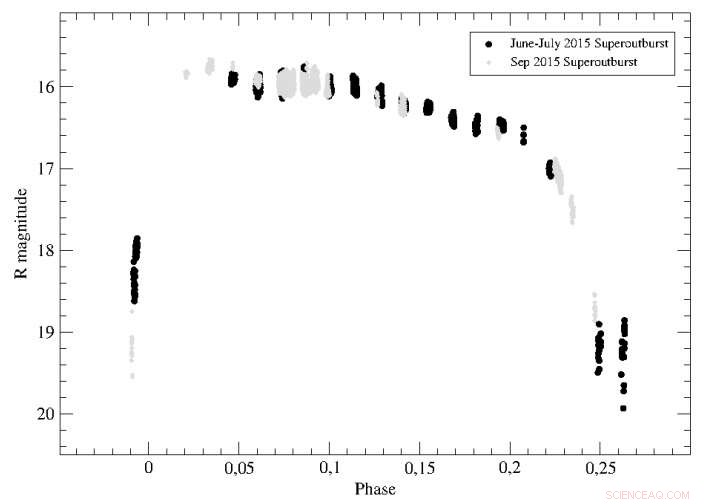
The light curve of MN Dra during superoutbursts folded with Psc = 74 days. Black circles correspond to the June - July 2015 superoutburst and grey circles represent the September 2015 superoutburst. Credit: Bąkowska et al., 2017.
(Phys.org)—A team of astronomers led by Karolina Bąkowska of the Nicolaus Copernicus Astronomical Center in Warsaw, Poland, has discovered several new outbursts in a peculiar, active dwarf nova known as MN Draconis. The results of new observations, which could provide better understanding of dwarf novae in general, were published Mar. 20 in a paper on arXiv.org.
MN Draconis (MN Dra for short) is an active SU Ursae Majoris-type (SU UMa-type) dwarf nova (DN). It is a poorly known active DN in the period gap and currently one of the only two known cases of period gap SU UMa objects showcasing quasi-periodic oscillations called superhumps.
Superhumps are observed in light curves of SU UMa systems during superoutbursts. Most common are positive superhumps - oscillations with periods a few percent longer than their orbital periods. However, MN Draconis exhibits negative superhumps, which means that the oscillations have periods that are slightly shorter than orbital periods.
SU UMa-type stars like MN Draconis are characterized by short orbital periods (shorter than 2.5 hours) and by the occurrence of superoutbursts, which are less frequent but one magnitude brighter than normal outbursts. Outbursts in MN Draconis were first spotted in 2002-2003. These observations derived the supercycle period (timespan between two successive superoutbursts) of MN Draconis to be about 60 days—one of the shortest among the values known in SU UMa stars. Now, Bąkowska and her colleagues present the results of an extensive world-wide observational campaign, which provided new essential information about this peculiar dwarf nova.
The new observations were carried out in 2009, 2013 and 2015. The astronomers used several ground-based observatories, including the Skinakas Observatory in Greece, the Poznan Astronomical Observatory, the Warsaw University Observatory (both located in Poland), the Borowiec Station in Italy, the Antelope Hills Observatory and the MDM Observatory (both in the U.S.). The observations allowed the team to measure fundamental parameters of the system by collecting photometric data and analysing the light curves, O − C diagrams as well as power spectra.
The scientists detected four superoutbursts and several normal outbursts. They also managed to characterize the occurrence of superhumps in superoutbursts, in outbursts, and in quiescence, along with their rates of change. Moreover, the researchers refined the supercycle length and possible changes in the superoutburst occurrence rate.
"Based on the two consecutive superoutbursts detected in 2015, the supercycle length was derived Psc = 74 ± 0.5 days and it has been increasing with a rate of P = 3.3 × 10⁻³ during last 12 years," the paper reads.
The authors noted that MN Draconis is the first discovered SU UMa system in the period gap with increasing supercycle length. It means that the occurrence of superoutbursts in this object has been constantly decreasing in recent decades. Such increased supercycle length could be crucial for our understanding of the future evolution of dwarf novae.
"MN Dra is another example of an active DN located in the period gap. It is worth noting that this star is not only a challenge for existing models of the superhump and superoutburst mechanisms, but also it presents other intriguing behaviours, in particular the increasing supercycle length," the researchers concluded.
© 2017 Phys.org