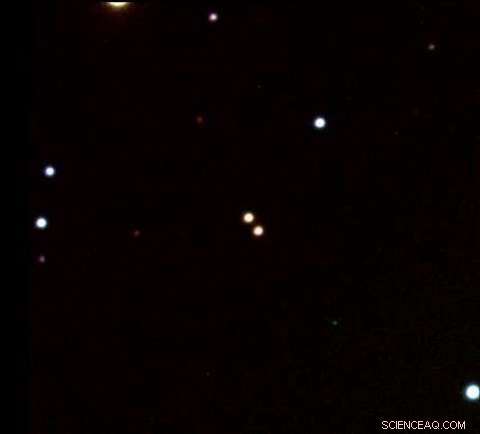
BV R color composite of PDS 11, with North up and East to the left. This 4′×4′ composite image is constructed from our observations with the HCT and is color coded as blue, green and red in B, V , R, respectively. The image is centered on PDS 11 binary system, with the northeastern component being PDS 11A. Credit: Mathew et al., 2017.
(Phys.org)—A team of Indian astronomers has recently studied a peculiar binary system designated PDS 11, revealing new insights into the nature of its stars. The findings, presented Mar. 17 in a paper published on arXiv.org, allowed the researchers to reclassify PDS 11 as an old, dusty, wide binary classical T Tauri system in which both components are actively accreting.
PDS 11 is an interesting object for astronomers, as it belongs to a rare class of isolated, high galactic latitude T Tauri stars—low-mass young stars in their pre-main sequence phase of evolution. Although such stars are often associated with cloud complexes such as Taurus, Orion and Ophiuchus, some of them are also found in isolated regions above the galactic plane and far from any dark clouds.
Last year, a team of astronomers led by Blesson Mathew of the Tata Institute of Fundamental Research in Mumbai, India, conducted an observational campaign of PDS 11, obtaining its optical and near-infrared spectra. The observations were carried out in February and March 2016 using the 2-meter Himalayan Chandra Telescope (HCT) located in Hanle, India. The spectra obtained by HCT delivered new important information about PDS 11's components, namely PDS 11A and PDS 11B.
"The spectra of both PDS 11A and PDS 11B look very similar due to the presence of Balmer emission lines, from Hα all the way up to H8 (8−2), Caii H & K emission lines and TiO absorption bands, albeit with different line strengths," the researchers wrote in the paper.
By analyzing the data from HCT observations, the team found that both PDS 11 stars are of M2 spectral type and show strong Hα emission, which indicates that they are classical T Tauri stars (CTTS) and are actively accreting.
The researchers also estimated the age of PDS 11A using the lithium depletion boundary method. They found that this star is between 10 and 15 million years old. Moreover, the team determined the distance of this component, which ranges from 371 to 427 light years. The age and distance of PDS 11B is taken to be similar to PDS 11A, due to the fact that the stars form a binary system.
Taking all the results into account, the researchers concluded that PDS 11 is the newest addition to a currently short list of old, dusty, wide binary classical T Tauri systems.
"Our analysis indicates that PDS 11 is the new addition, after TWA 30 and LDS 5606, to the interesting class of old, dusty, wide binary classical T Tauri systems in which both components are actively accreting," the paper reads.
Furthermore, due to the fact that PDS 11A is accreting and lacks hot dust material close to the star, the team assumes that it could be a transition disk candidate. They also need to assess whether the near-infrared excess in PDS 11B is entirely due to circumstellar material or due to the contribution from a late-type companion.
"If confirmed, this would be the first known example of a >10 Myr old binary system, where one of the components harbors a radially continuous full disk, while the other is surrounded by a disk with inner hole or gap," the astronomers wrote.
© 2017 Phys.org