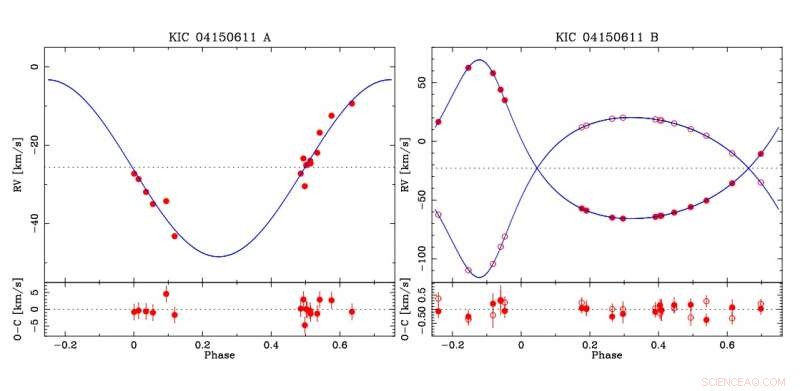
Radial velocity curves of the components A (left) and B (right) of KIC 4150611, phase folded with their orbital periods. The best-fitting models are plotted with blue lines. Filled circles on the right panel refer to the primary Ba, and open ones to the secondary Bb. Phases 0 are set for the eclipse mid-times (the deeper one in case of B). Credit: Hełminiak et al., 2017.
(Phys.org)—A team of astronomers led by Krzysztof Hełminiak of the Nicolaus Copernicus Astronomical Center in Toruń, Poland, has investigated an interesting bright quintuple stellar system in which each of the stars is eclipsed. The quintet, designated KIC 4150611 (also known as HD 181469), given its peculiar pulsations, eclipses, and high-order multiplicity, could provide important information on evolution and structure of multiple-star systems. The new research was published Mar. 2 in a paper on arXiv.org.
KIC 4150611 is a quintuple star system that was initially identified as a visual binary star in 2001. However, the object's first position measurement dates back to 1831. The eclipses in the system were first noted in 2011 in the Kepler Eclipsing Binaries Catalog (KEBC). Shortly after, it was found that KIC 4150611 contains a hybrid delta Scuti (δ Sct)/gamma Doradus (γ Dor) pulsator. In 2015, a spectral analysis of this pulsator was performed and its atmospheric parameters were obtained, showing that it is a rapidly-rotating star of spectral type F1 V mA9.
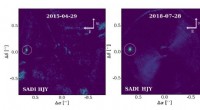
Now, Hełminiak's team reveals new insights into the composition of this interesting stellar system. The researchers have recently published the results of their observations of KIC 4150611, which were conducted between 2013 and 2016. They have analyzed the eclipses seen in the Kepler light curve, radial velocities from HIDES spectrograph attached to the 1.88-m telescope of the Okayama Astrophysical Observatory (OAO) in Japan and adaptive optics observations from the Keck II telescope in Hawaii. All these data allowed them to distinguish five components of KIC 4150611 and to characterize their parameters.
"The HIDES spectra were used for determination of radial velocities, thus masses of the two G-type stars on the 8.65-day orbit. These masses were then used to assess the age and evolutionary status of the system. This would not be possible without spectroscopy," Hełminiak told Phys.org.
"What we know for sure is that there are at least five stars in a funny configuration, where each of them is somehow eclipsed. I'm not sure we know another system like that. We also know that the brightest component is a weird pulsator: a hybrid that shows both delta Scuti and gamma Doradus types of pulsations. A few decades ago, we had no idea such stars can exist, and before Kepler and CoRoT (Convection, Rotation and planetary Transits) space observatories, we only knew a few," he added.
The researchers managed to directly measure physical parameters of two components of KIC 4150611, designated Ba and Bb, which allowed them to determine that this is a relatively young system. From the estimated age, they inferred properties of three other components, namely Aa, Ab1 and Ab2.
According to the paper, Aa is the hybrid pulsator and the brightest component of the system. This pulsator is transited approximately every 94 days by Ab1 and Ab2—a pair of K/M-type stars forming a 1.52-day eclipsing binary. When it comes to Ba and Bb, the study reveals that they are late G-type stars, which form another eclipsing pair with a period of about 8.65 days.
"For the first time, we get the masses and radii of the G-type stars (8.65-d pair), and the age of the system. We have the architecture of the system confirmed. Till now there were only guesses. Quite good ones, but nothing certain has been published," Hełminiak noted.
Moreover, the researchers assume that somewhere in the field of view, there is yet another eclipsing pair, but they do not know if it is related to the system or not. Hełminiak claims that some of the new results may be explained by another body in the system.
© 2017 Phys.org