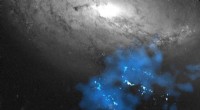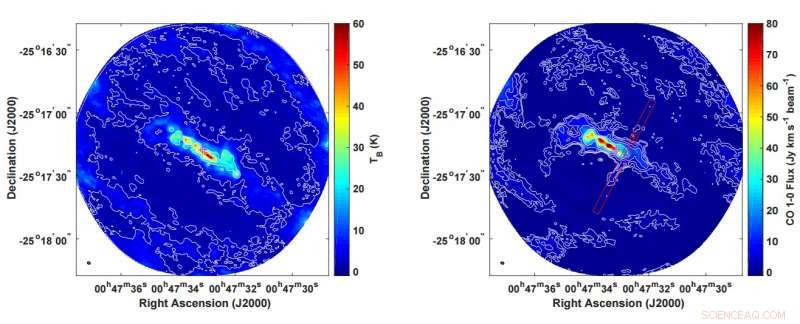
ALMA CO(1–0) observations of NGC 253. Credit: Walter et al., 2017.
(Phys.org)—An international team of astronomers led by Fabian Walter of the Max Planck Institute for Astronomy in Germany has revealed essential properties of a molecular outflow feature in the nearby starburst galaxy designated NGC253. The findings were presented in a paper published Jan. 18 on the arXiv pre-print repository.
NGC 253, also known as the Sculptor Galaxy, is an intermediate spiral starburst galaxy in the constellation Sculptor some 11 million light years away. The galaxy is one of the brightest spiral galaxies visible and also one of the dustiest. Due to its proximity and the fact that it is currently undergoing a period of intense star formation, it serves as one of the best laboratories to study starburst–driven galactic–scale winds in detail.
NGC 253 is known for the galactic wind emerging from its central area, which carries significant amounts of molecular gas. In order to better characterize this emission, Walter and his team carried out a series of observations between November 2013 and August 2014 utilizing the Atacama Large Millimeter/submillimeter Array (ALMA) in Chile. This observational campaign allowed the researchers to uncover crucial properties of the studied molecular outflow.
"We present a detailed study of a molecular outflow feature in the nearby starburst galaxy NGC 253 using ALMA," the paper reads.
According to the study, NGC 253's most prominent outflow feature towards the south has a projected length of about 978 light years, a width of approximately 163 light years, and a velocity dispersion of 40 km s−1. The scientists note that its extent and dispersion are consistent with an ejection from the galaxy's disk starting about 1 million years ago.
The kinematics of the molecular gas in this feature show that the material is approaching us and is also accelerating. However, the astronomers were unable to determine whether or not the molecular mass entrained in the outflow will escape the galaxy, or be recycled to fuel later episodes of star formation. More observations are required to draw final conclusions.
"The kinematics of the molecular gas are consistent with accelerating with a velocity gradient of 1 km s−1 pc−1, and at its last measurable point it approaches the escape velocity. (…) More sensitive ALMA observations will trace the outflow even further out, and will shed light on whether or not part of the ejected molecular material will escape the galaxy," the researchers wrote in the paper.
The team also discovered bright tracers of dense molecular gas like HCN, CN, HCO+, CS in the molecular outflow. Moreover, they found that line ratios HCN/CO measured in the outflow are high and consistent with ratios observed in the central starburst region of NGC253 and in other starbursts, while the HCN/CO line ratio in the galaxy's disk is significantly lower, which is typical for gas in the disks of nearby galaxies. The researchers concluded that this indicates that the dense molecular gas is retaining its properties in the process of its ejection from the central regions into the outflow.
© 2017 Phys.org