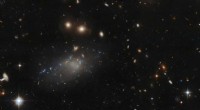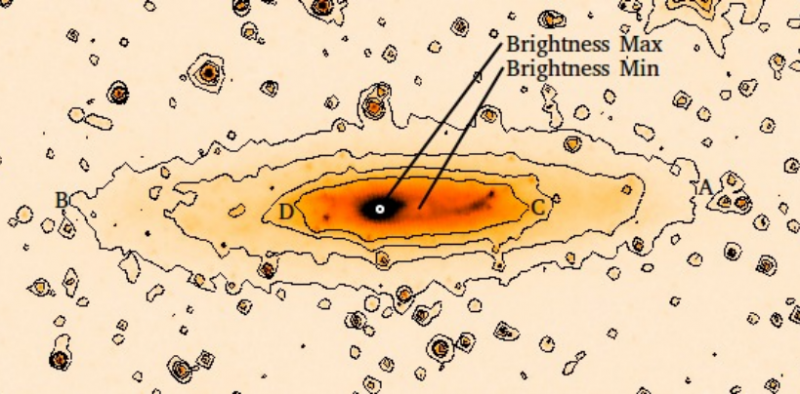
Spitzer IRAC image of NGC 5523 at 3.6µm, displayed in a log scale. oints A and B denote the apsides of the outer disk, and similarly points C and D denote those of the inner disk. he Brightness Maximum indicates the center of the nucleated bulge and the Brightness Minimum describes the isophotal center of GC 5523. The major axis runs east-west with east at the right edge of the image and north at the bottom edge. Credit: Fulmer et al., 2016.
(Phys.org)—The spiral galaxy NGC 5523 is believed to be an example of an isolated galaxy whose evolution was not influenced by other objects. However, a new study conducted by U.S. astronomers shows that the isolation of NGC 5523 could be due to its past minor mergers with surrounding low-mass galaxies. The findings are detailed in a paper published Nov. 18 on arXiv.org.
Located some 67 million light years away, NGC 5523 is a normal late-type isolated spiral galaxy. With a stellar mass of about 10 billion solar masses, it is separated from its closest neighbor by more than 3 million light years. Furthermore, previous studies of NGC 5523 have not found any evidence of interaction with surrounding objects in the past 2 million years, which allowed the scientists to classify it as an isolated galaxy.
Recently, new research carried out by a team of astronomers led by Leah Fulmer of the University of Wisconsin-Madison, provided evidence indicating that past mergers could have produced NGC 5523. Their hypothesis is based on new observations of the galaxy's structure.
"NGC 5523's complex inner structure, in combination with its global isolation and homogenous outer structure, have most likely been produced by mergers with its nearest neighbors: a process of isolation by annexation," the researchers wrote in the paper.
In order to investigate NGC 5523's structure in detail, the team analyzed images from NASA's Spitzer Space Telescope, the Sloan Digital Sky Survey (SDSS) and the WIYN 3.5-m telescope in Arizona. These multi-band images allowed them to distinguish a nucleated bulge-like structure embedded in a spiral disk.
The researchers found that this bulge is offset by about 6,000 light years from a brightness minimum at the center of the optically bright inner disk. According to them, this offset is one of the indicators of past interactions. Moreover, they detected a tidal stream crossing the plane of the inner disk, which supports the hypothesis of a recent merger.
"Evidence for such interactions includes the offset between the inner/outer disks, the prominence of the tidal stream, and the properties of the nucleated bulge. (…) Furthermore, the tidal stream, likely a remnant from an interaction with a bound dwarf companion, indicates a more recent merger," the paper reads.
The astronomers noted that the mergers that led to creation of NGC 5523 must have been "soft" given the fact that the extreme regularity and symmetry of the outer disk of the galaxy. This suggests that any disturbance caused by a merger must have been mild enough to maintain the integrity of the primary host galaxy. Therefore, they concluded that one or more non-disruptive mergers could have occurred between NGC 5523 and companion galaxies or satellites.
"Our study of the evolution of the isolated galaxy NGC 5523 offers a counterexample to simple assumptions about isolated galaxy evolution. (…) We conclude that the asymmetric internal structure of NGC 5523 is the product of one or more past minor mergers with surrounding low-mass galaxies," the scientists wrote.
© 2016 Phys.org