Rotation and revolution are often confused, but there are distinct differences between the two. Each describes a different process altogether, and understanding these differences can help clarify your perception of the way our solar system is organized, and how our planet relates to it. For a simple reference, remember that the Earth rotates around its axis and revolves around the Sun.
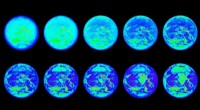
Rotation is when a planet moves on its own axis. One rotation is completed when a planet turns on its axis once. During rotation, a planet's position changes only with respect to its axis, not to other celestial bodies. An axis can not be seen, but is an imaginary line that runs through a planet. On Earth, the axis of rotation is located in a straight line between the North and South poles. Though the Earth is tilted about 15 degrees, it rotates along this imaginary line as if it were a straight line.
A revolution describes when a planet moves around a central celestial body, such as the Sun. The word revolution comes from the 1500s astronomer Copernicus, who published a theory titled "On the Revolution of Planets." In this theory, he described what we now know to be true, that the planets in our solar system revolve around the Sun and not the Earth. For this reason, the revolution of planets is named after his theory.
The Earth takes 365 days to revolve around the sun, but only 24 hours to rotate on its axis. Armed with this knowledge, it may seem as if a revolution always takes much longer than a rotation, but this is not the case. For instance, the moon rotates around its axis and revolves around the Earth in the same amount of time, 27 days. This is the reason we always see the same side of the moon at all times of the year.
Both revolution and rotation are essential to the way that our planet functions. The revolution of our planet around the Sun provides us with the various seasons throughout the year, as our elliptical orbit moves us closer and farther away from the Sun. The Earth's rotation is responsible for the distinctions between night and day; as it spins different parts of the planet are exposed to the Sun.