Digital Vision./Digital Vision/Getty Images
Dust storms form when winds lift microscopic rocky particles—often just a few micrometers in diameter—into the atmosphere. These particles can remain airborne for hours to months, and when they eventually settle, they can loosen additional material from the surface. To date, scientists have observed such phenomena only on Earth and Mars.
Planetary atmospheres receive more solar energy at their equators than at the poles, creating a temperature gradient and, consequently, a pressure gradient. The atmosphere moves to restore balance: warm air rises near the equator, travels poleward where it cools, and returns equatorward. The planet’s rotation further modulates global wind patterns.
Although all rocky planets with atmospheres should, in principle, support dust storms, neither Mercury nor Venus exhibit them. Mercury’s thin CO₂ atmosphere is continually stripped by the solar wind, and while dust from meteoroid impacts has been detected, no sustained storms occur. Venus, once thought to host swirling dust-driven winds, actually possesses a dense CO₂ atmosphere with layers of sulfuric‑acid clouds that dampen dust motion.
On Earth, dust storms are most common during prolonged droughts. In the United States, towering plumes can obscure the land and reduce visibility. Warm air can lift dust from the Sahara up to 4,500 m (≈14,800 ft) and transport it across the Atlantic, polluting the Caribbean. Dust from the Gobi Desert can be carried into the Pacific, but once it reaches the ocean, the lack of additional surface material causes the storm to dissipate.
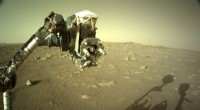
Mars hosts the largest dust storms in the solar system. Its thin CO₂ atmosphere—about 1 % of Earth’s density—allows winds to loft iron‑oxide dust that blankets the planet. These storms can cover the entire globe and last for months. Dust absorbs sunlight, warming the atmosphere and driving winds toward the poles; the resulting updrafts lift even more dust, creating a self‑sustaining cycle. As a global desert, Mars supplies ample surface dust to fuel these persistent storms.