Photo by Digital Vision/Getty Images
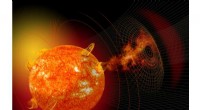
Every sunrise brings a familiar glow, but beneath the steady light lies a dynamic Sun teeming with energetic particles. Occasionally, the Sun releases powerful bursts of energy—solar flares—often accompanied by coronal mass ejections (CMEs). While these events pose little risk to human health, they can wreak havoc on the technology that underpins our modern world.
Solar flares emit a broad spectrum of radiation—radio waves, visible light, ultraviolet, X‑rays, and gamma rays—rushing out like a colossal searchlight. Most of this energy is harmless, but high‑energy ultraviolet, X‑rays, and gamma rays can penetrate the shielding of satellite electronics. Although satellites are equipped with radiation‑hardened components, extreme flares—estimated to occur roughly every 500 years—could temporarily or permanently damage onboard circuitry. Such damage can degrade services ranging from Global Positioning System accuracy to television and radio broadcasts.
The Sun’s high‑energy radiation is absorbed in the Earth’s upper atmosphere, heating it slightly and causing a measurable expansion. This expansion increases atmospheric drag on satellites skimming the edge of orbit, shortening their operational lifespans. Additionally, the altered ionization profile can disrupt radio propagation, affecting long‑range communications and navigation signals.
Not every solar flare launches a CME, and not all CMEs are dangerous. When a massive CME heads toward Earth, the planet’s magnetosphere captures its charged particles, causing them to spiral along magnetic field lines until they collide with atmospheric atoms. This interaction produces the aurorae visible near the poles and drives geomagnetically induced currents (GICs) in the Earth’s surface.
GICs can travel along long transmission lines, creating surges that stress transformers and generators. While the induced currents are minimal at the Earth’s surface, they accumulate over hundreds of miles of conductors, resembling lightning strikes that can damage or destroy equipment connected to the grid. Fortunately, only the most powerful CMEs generate measurable surges, and space‑weather forecasters typically provide warnings 12–48 hours in advance. Unplugging sensitive electronics during a predicted storm can safeguard household devices, but the primary concern remains the resilience of national power infrastructure.
Understanding these solar-terrestrial interactions is essential for engineers, policymakers, and the public to mitigate risks and maintain the reliability of critical technology systems.