By Joseph Nicholson Updated Mar 24, 2022
The Sun is a colossal hydrogen‑burning furnace that radiates about 4 × 10^26 watts every second. This continuous output powers not only the light and heat we feel but also all the energy that eventually reaches Earth, including the fossil fuels that drive our modern world. The mechanism behind this prodigious output is nuclear fusion.
Hydrogen—the lightest and simplest element—consists of one proton and one electron. In the cool outer layers of a nascent star, the positive charge of the protons keeps them apart. As the protostar collapses under gravity, temperatures and pressures in its core rise until the hydrogen nuclei can overcome their Coulomb barrier. At roughly **8 million K**, four protons undergo the proton‑proton chain, merging to form a helium‑4 nucleus while converting a small fraction of mass into energy via E = mc². As the core temperature climbs further, heavier nuclei become accessible; at about **100 million K**, three helium‑4 nuclei fuse in the triple‑alpha process to create a carbon‑12 atom.
The energy released by fusion appears first as high‑energy gamma rays. These photons must traverse the Sun’s interior before escaping into space. Immediately surrounding the core is the radiation zone, so dense that photons can take on average **171,000 years** to make their way out—sometimes up to several million years. Next comes the convection zone, where hot plasma rises and cooler plasma sinks in a turbulent dance. In this zone, gamma rays are gradually degraded into lower‑energy photons, mainly visible light, as the energy propagates toward the surface.
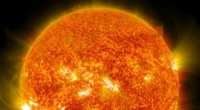
The photosphere—the Sun’s visible surface—has a temperature of roughly **4,500–6,000 K**. Above it lies the corona, the site of sunspots and solar prominences. When the photons finally exit the photosphere, about half of the energy arriving at Earth is visible light, another half is infrared, and a smaller but significant portion is ultraviolet radiation, which can be hazardous to living organisms. Solar photons travel at the speed of light, covering the ~150 million kilometre distance to Earth in approximately **eight minutes**.