By Isaiah David Updated Mar 24, 2022
Galaxies are vast assemblies of dust, gas, stars, and other celestial bodies that span immense regions of space. Our own Milky Way contains more than a hundred billion stars spread across tens of thousands of light‑years.
Elliptical galaxies range from nearly spherical to elongated shapes. Their light is concentrated toward the center, fading toward the edges. Because their stars orbit in random, individual paths rather than a coherent rotation, ellipticals lack the pronounced spin seen in spirals. The stellar populations are predominantly old, giving these systems a reddish hue, and their dust content is low, so new star formation is rare. Astronomers believe many ellipticals formed during a relatively brief period in the early universe.
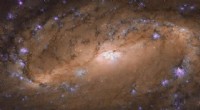
Spiral galaxies—including the Milky Way—exhibit a bright central bulge surrounded by winding arms that lie in a common plane, resembling a flattened pinwheel. The arms are rich in gas and dust, sites of ongoing star formation, which is why they appear blue and luminous. The inter‑arm regions and the central bulge host older, dimmer stars. Spirals rotate as coherent, disk‑like structures, and they are classified by the tightness of their arms and the prominence of their bulge.
Irregular galaxies are a heterogeneous group that does not fit the elliptical or spiral mold. They are less common and generally smaller, often containing only a few million stars. Type I irregulars show blue, young stars and a flattened disk but lack a well‑defined nucleus. Type II irregulars are even rarer and encompass a wide variety of unconventional morphologies.