Digital Vision./Photodisc/Getty Images
Uranus, the seventh planet in our solar system, sits just beyond Saturn’s glittering ringed world. Despite its prominence, it has received far less scrutiny—only Voyager 2 skimmed close enough to capture detailed images. That flyby revealed no surface activity on Uranus itself, because the ice giant lacks a solid crust. Instead, any geologic drama unfolds on its moons.
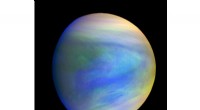
Seen from afar, Uranus is a smooth, sky‑blue sphere. Its hue stems from methane and water‑ice clouds that blanket the upper atmosphere, while a deep hydrogen‑helium envelope stretches all the way to an icy core. This core holds about 80 % of the planet’s mass, yet occupies only roughly 20 % of its radius. Uranus possesses a weak, highly tilted magnetic field—leaning 60° from the rotational axis—and its spin axis lies almost in the same plane as its orbit, a curious geometric alignment that puzzles astronomers.
The unusual magnetic orientation hints that Uranus’ interior is largely liquid, contrasting with the solid cores of Saturn and Jupiter. Scientists speculate that the liquid may be a pressurized mixture of carbon, water, and methane. Under the extreme pressure, carbon could crystallize into diamond—creating floating diamond “islands” that swirl within the planet’s molten heart.
While Uranus itself shows no surface changes, its moons do. As of 2014, the planet boasts 27 moons; five—Titania, Oberon, Umbriel, Ariel, and Miranda—are large enough to be spotted from Earth with telescopes, while the remaining 22 were cataloged by Voyager and the Hubble Space Telescope. Oberon and Umbriel appear heavily cratered and ancient, whereas Titania, Ariel, and Miranda exhibit signs of ongoing geology.
Ariel boasts the smoothest terrain of any Uranian satellite, with small, shallow craters suggesting gentle impacts. Its surface shows evidence of ice flows and fault‑induced valleys, hinting at tectonic activity. Miranda, in contrast, is a patchwork of diverse terrains—old, heavily fractured regions juxtaposed with younger, more tectonically reshaped surfaces. The moon’s proximity to Uranus generates tidal heating, likely powering this dynamic geology.